Connect to Literacy™ is Summit K12's supplemental Literacy & English language development (ELD) program for K–12 English learners, from newcomers to long-term English learners. Each student follows a Personalized Learning Plan across listening, speaking, reading, and writing, built from their assessment scores and directly mapped to their state ELP standards.
.avif)
Our Connect to Literacy™ program is designed to provide targeted support for educators, administrators, students, and families, so every multilingual learner – including young learners, newcomers and long-term English learners – makes measurable growth every year.
Provides structured, research-based lessons to ensure students develop strong language skills.
Grouping reports sort students by proficiency level and suggest matching strategies for small-group ELD.
Gives educators real-time insights into student performance and growth.
Scores speaking and writing instantly across 112 linguistic dimensions; teachers can always override.
Provides a clear instructional roadmap to support consistent language development.
Tracks student progress with data-driven insights for informed decision-making.
Prepares students with test-aligned tasks to improve performance.
Tracks each student's progress toward exit criteria and helps long-term English learners reclassify.
Ensures all MLLs gain at least one proficiency level per year, backed by a money-back guarantee.
Uses validated assessment data to project state ELP assessment success.
Engaging instructional materials provide students with interactive learning experiences.
Age-appropriate pathways from K–1 (Trailblazers) to newcomers in grades 2–12 (Essentials).
Targets individual student needs in listening, speaking, reading, and writing.
Available in 40+ languages to keep families informed about student growth.
Allows parents and guardians to participate in English learning alongside students.
Provides interactive sessions to support multilingual learners at home.
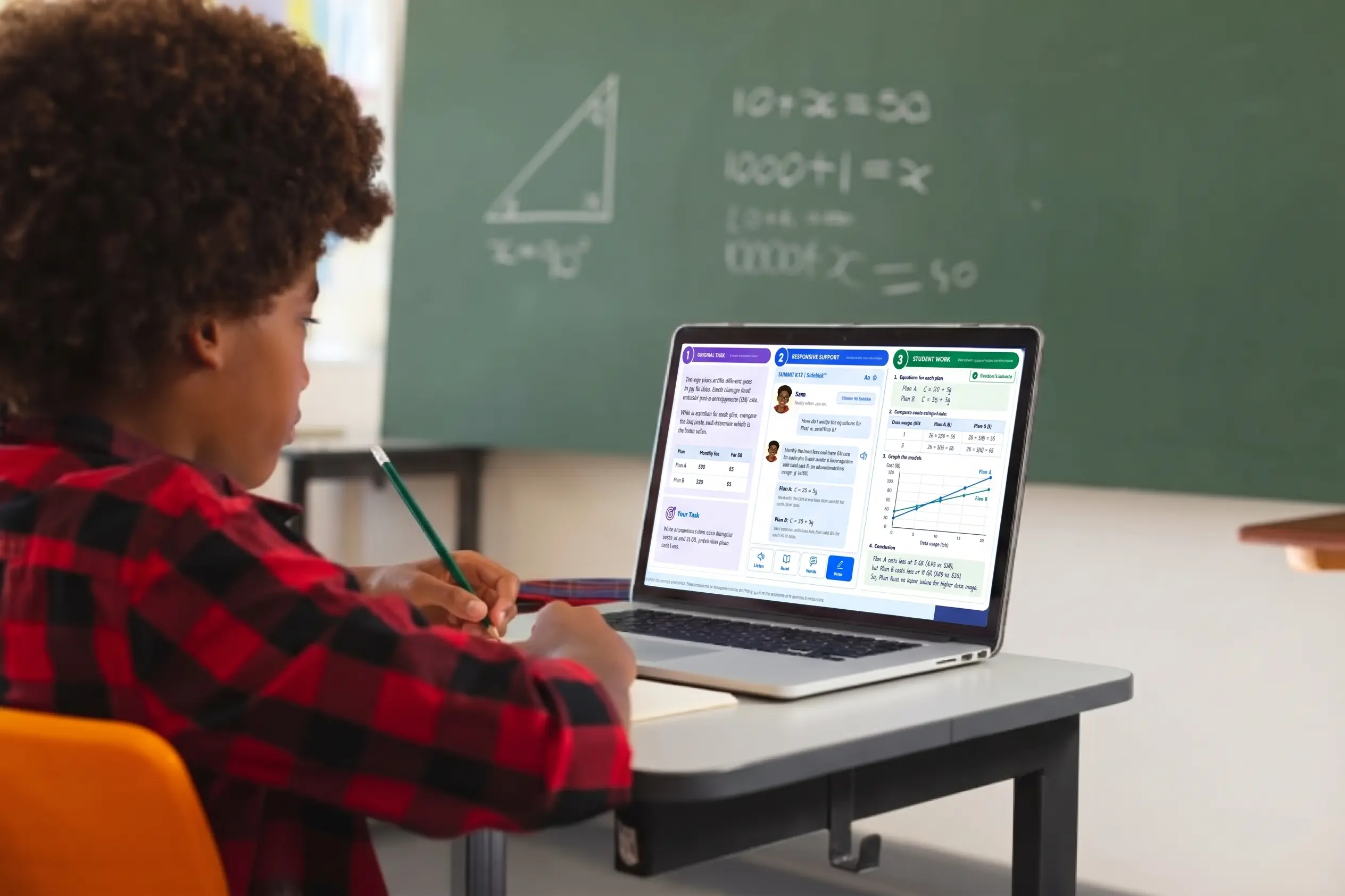
Coming soon:
Multilingual learners use academic English all day, not just during ELD. Summit Sidekick is a browser extension for Chrome, Edge and Safari that extends language support into every lesson. It pulls in each student's Connect to Literacy data, so the supports they need stay with them and adapt as their proficiency grows. Language learning carries into every classroom, and content teachers stay focused on their subject.

Supplemental English language development (ELD) is targeted instruction that adds to a school's core curriculum to help English learners build proficiency faster. It gives students extra, focused practice in listening, speaking, reading, and writing at their current level. Summit K12's Connect to Literacy™ is a supplemental ELD program: students follow a Personalized Learning Plan while teachers get data to guide small-group instruction that drives meaningful growth at every proficiency level.
Districts should look for five things in a supplemental ELD program: alignment to their state ELP standards and assessment, practice in all four language domains, personalization by proficiency level and grade, actionable data for teachers, and published evidence of results. Connect to Literacy™ aligns to ELPAC, TELPAS, WIDA ACCESS, ELPA21, or AZELLA ELPA, builds a Personalized Learning Plan for each student, and meets ESSA Tier II (Moderate Evidence) standards.
The four domains of English language development are listening, speaking, reading, and writing. Listening and reading are interpretive (receptive) skills; speaking and writing are expressive (productive) skills. State ELP assessments such as ELPAC, TELPAS, WIDA ACCESS, and ELPA21 score all four. Connect to Literacy™ gives every student practice in each domain, and administrators can prioritize or combine domains to fit their program model.
Connect to Literacy™ differentiates by proficiency level, grade band, and pace. Each student's pathway is built from their own scores in each domain, and content is filtered to be age- and grade-appropriate. Grouping reports sort students by proficiency level and provide proficiency-aligned instructional strategies, so teachers can plan small groups and provide instruction that drives meaningful growth for every learner.
Connect to Literacy™ uses AI auto-scoring to give students immediate feedback on speaking and writing tasks. The AI evaluates 112 linguistic speaking dimensions and is calibrated against thousands of teacher-rated writing responses by proficiency level and grade band. Students hear feedback read aloud and see a revised version of their own response. Teachers see the rubric, feedback, and revision in one view and can always override the score.
Language development and literacy grow together: students need oral language, vocabulary, and sentence structure to understand what they decode. For multilingual learners, building English and building reading skills at the same time works better than treating them separately. Connect to Literacy™ combines language practice across all four domains with code-based and language foundation skills, so students strengthen English and reading in one pathway.
Yes. Connect to Literacy™ uses a Science of Reading-based approach adapted for multilingual learners. It combines explicit foundational literacy instruction with oral language, academic discourse, vocabulary, and comprehension support. Summit K12's literacy work addresses phonological awareness, decoding, fluency, vocabulary, morphology, syntax, and comprehension, and pairs them with second language acquisition research.
Schools can support reading by teaching foundational skills explicitly while building the oral language and vocabulary students need to make meaning. Connect to Literacy™ does this inside each student's pathway, and Accelerate to Literacy™ adds an optional six-week grade-level literacy pathway for grades 3–8 and 11. In a 2025–26 matched-comparison study, 60.5% of C2L users met their Projected Reading Growth targets, compared with 56.5% of matched peers taking the same NWEA MAP assessment.
A Personalized Learning Plan (PLP) is an individual pathway of ELD practice items matched to a student's proficiency in each language domain. In Connect to Literacy™, students move through up to three PLPs a year. Each starts with a progress assessment or state proficiency score upload, sequences skills automatically, and updates as the student demonstrates growth on integrated benchmark assessments or across their average scores. Students who finish early get an advanced "bonus" pathway.
Summit K12 imports each student's state English language proficiency scores, including scale scores by domain where available, to build their first Personalized Learning Plan. Scale scores show growth within a proficiency level, so two students at the same level can start on different pathways. The newcomer on-ramp and Essentials content provides additional support for newcomers or L1 students, providing scaffolds and language supports where needed. The Trailblazers curriculum provides an engaging experience for K–1 learners that builds language and literacy together in a unique touch-first learning environment.
The Task Demand Framework is Summit K12's system for tagging every ELD activity by how demanding it is. More than 50,000 items are tagged for linguistic, cognitive, and interaction complexity, plus domain, content area, and grade band. Connect to Literacy™ uses these tags to raise difficulty gradually within each pathway, creating thousands of possible starting pathways per grade band to ensure students receive an appropriate level of challenge throughout their PLP.
Summit K12 supports newcomers through Essentials, a pathway inside Connect to Literacy™ for newcomers and Level 1 students in grades 2–12. Essentials teaches social and conversational English first, with age-appropriate versions for grades 2–5, 6–8, and 9–12, then moves students toward academic language. A six-week newcomer on-ramp adds visual supports and retry-and-feedback loops. Directions are available in writing and audio in 40+ home languages.
Yes. Trailblazers is a K–1 pathway inside Connect to Literacy™ that builds language and early literacy together for the youngest multilingual learners. It is iPad-first and touch-based, with audio and visual guidance so students don't need to read directions. A friendly character, Benny the Bear, leads students through 9 themes and 28 trails tied to K–1 classroom topics, with encouraging feedback along the way. Trailblazers is designed to be used as a supplementary ELD solution for independent practice, small- or whole-group instruction.
Summit K12 helps Long Term English Learners (LTELs) by targeting the specific domains holding them back, most often academic reading and writing. Connect to Literacy™ builds each student's pathway from domain-level scores, and practice mirrors the task types on their state ELP assessment. In Texas and California, Summit Insights™ forecasts reclassification and flags students at risk of becoming LTELs so teams can act earlier.
Districts raise reclassification rates by tracking each student's progress toward exit criteria all year, targeting the weakest domains, and giving students practice that mirrors the state ELP assessment. Summit K12 supports each step with progress assessments up to three times a year, domain-level pathways, and aligned practice. Palm Springs USD reported a reclassification rate above 17% and the highest ELPI levels after using Connect to Literacy™.
Connect to Literacy™ aligns to state ELP assessments across the U.S., with state-specific versions for ELPAC (California), TELPAS (Texas), AZELLA ELPA (Arizona), WIDA ACCESS (WIDA states), and ELPA21 (ELPA21 states). Practice is modeled on each test with task types that mirror the format of the assessment. Each version aligns to that state's ELP standards.
Yes. Connect to Literacy™ has a version for WIDA states that aligns practice to the WIDA ELD Standards Framework and WIDA ACCESS™️ assessment, including the 5 ELD standards, 4 key language uses, language expectations, and proficiency level descriptors. Pathways are organized into interpretive (listening, reading) and expressive (speaking, writing) modes. WIDA™ and ACCESS™ are marks of the University of Wisconsin; Summit K12 is not affiliated with or endorsed by WIDA.
Summit K12 monitors progress with up to three ELD progress assessments a year (beginning, middle, and end-of-year) plus ongoing formative checks. Teachers see pacing reports showing whether each student is ahead, on, or behind pace, and a Performance Indicator comparing assessment scores against PLP work. Administrators get a dashboard with scores, proficiency growth, and progress across classes and schools.
Summit K12 uses its progress assessment data to project how students are likely to perform on the state ELP assessment, so leaders can see who is on track before test day. The Performance Indicator flags students whose practice and assessment results suggest they need more support. In Texas and California, Summit Insights™ adds detailed reclassification forecasting and aggregates real-time proficiency scores with state ELP assessment records.
Yes. In an independent 2025–26 matched-comparison study of multilingual learners in a large urban district, 60.5% of Connect to Literacy™ users met their NWEA MAP Reading Projected Growth targets, compared with 56.5% of matched peers (p < .001). An earlier 2024–25 study of 19,100 students in grades 2–8 in a large Texas district found 26% higher MAP Reading growth for high-fidelity users, and the share at TELPAS Beginning fell from 44.8% to 21.6%, while Intermediate rose from 36.7% to 55%.
Summit K12 guarantees that each English learner using Connect to Literacy™ will grow at least one proficiency level per school year on the state ELP assessment, or the district receives a license fee refund or credit. The guarantee applies to TELPAS, ELPAC, and WIDA™️ ACCESS™️ states, among others. Conditions include schoolwide or districtwide purchase, professional development, implementation by September, and completed assessments and PLPs.
Connect to Literacy™ saves teachers time and shows them where to focus. AI auto-scoring handles first-pass scoring of speaking and writing. Grouping reports, proficiency-aligned strategies, instructional flipbooks, and lesson model videos support small-group planning. Teachers can assign work to multiple classes in one step. Initial training, follow-up coaching, and on-demand Learn Videos for Teachers are part of implementation.
Summit K12 keeps families informed and involved in their home language. Connect to Literacy™ provides progress reports and parent letters in 40+ languages, free family logins so parents can learn English alongside their child, and free family workshops in Spanish and English. In Texas and California, Summit Insights™ sends required parent notifications in 90+ languages.
Language development doesn't stop when students leave ELD. They keep using and building academic English in science, math, social studies and every other class. Connect to Literacy™ builds proficiency during ELD time, and Summit Sidekick, coming soon, will carry language support into lessons across the school day. Sidekick is a browser extension for Chrome, Edge and Safari. Where districts also use Connect to Literacy, it pulls in each student's learner data so supports match their proficiency, and content teachers don't have to become ELD specialists. A free pilot begins in Spring 2027 for Connect to Literacy partner districts that register interest.