Black and blue Mountain Achieve logo with stylized 'A' wearing a graduation cap.

CCMR Made Simple

Texas's new HB 8 law introduces differential weighting for CCMR indicators starting with the Class of 2030 — not all pathways will count equally toward your score. Get the real-time data, interventions, and support you need to prepare now.

Summit Achieve is a real-time Post Secondary Readiness and Outcomes Bonus solution with built-in TSIA2 interventions, built to meet TEA A–F standards, including the 2030 differential weighting.

CCMR Indicators Monitoring

Monitor CCMR sub-indicators aligned to current and upcoming differential weighting that identify high-impact student gaps.

Intervention Engine—Including TSIA2 Prep

Identify and support all students with auto-assigned, prescriptive interventions that ensure college and career readiness.

Outcomes Bonus Calculator

Connect specific interventions to Outcomes Bonus funding through granular modeling for every student.

CTE Completers and IBC Tracking

Track Career and Technical Education (CTE) completer status and industry-based certification (IBC) attainment to ensure CCMR alignment.

Graduation Plan &
CTE Program of Study Alignment

Map each student’s Personalized Graduation Plans and get digital signatures, maintaining an audit trail.

Professional Development

Build district capacity and prepare your team to lead CCMR improvement all year long.
Understand How HB 8 Differential Weighting Could Affect Your Rating

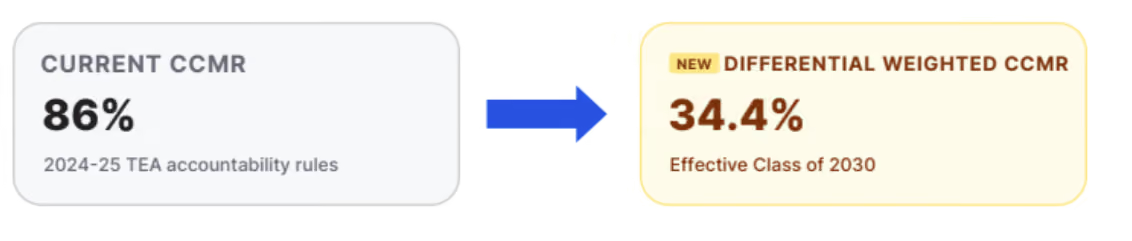
Comparison of current CCMR 86% for 2024-25 and new differential weighted CCMR 34.4% for class of 2030.

A district currently reporting 86% CCMR could see that figure fall to 34.4% under the new differential weighted calculation — enough to drop an entire letter grade.

A-F letter-grade changes: Overall and Student Achievement downgraded B to C; School Progress and Closing Gaps unchanged.

Overall District Accountability Projections
Example based on real district data modeled through Summit Achieve's HB 8 projection engine.
‍

Close CCMR Gaps Before They Cost You

Most districts leave Outcomes Bonus funding unclaimed because they can't see which students are close to meeting CCMR thresholds or don’t have the interventions in place to support them. Summit Achieve solves both of these problems. 

Our interactive calculator applies TEA's HB 8 weighted methodology to your real data, so you can model exactly how many students — and how much funding — strategic action can unlock.


Key Features of the Calculator

  • Calculated weighted CCMR
  • Interactive sliders to model adding met-OB graduates
  • Auto-aligns with every TEA accountability refresh
  • Funding and letter-grade impact side by side
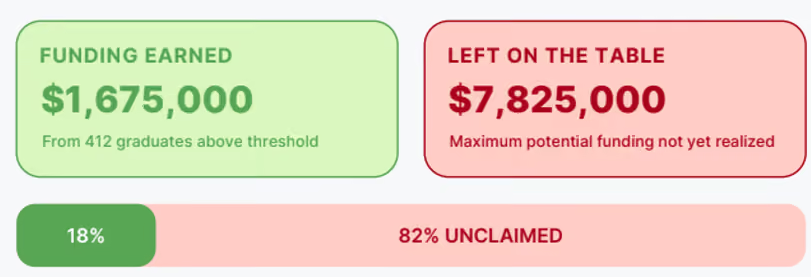
Funding earned $1,675,000 from 412 graduates; $7,825,000 left unclaimed potential funding.
Blue rightward arrow with two vertical lines on its left side on a white background.
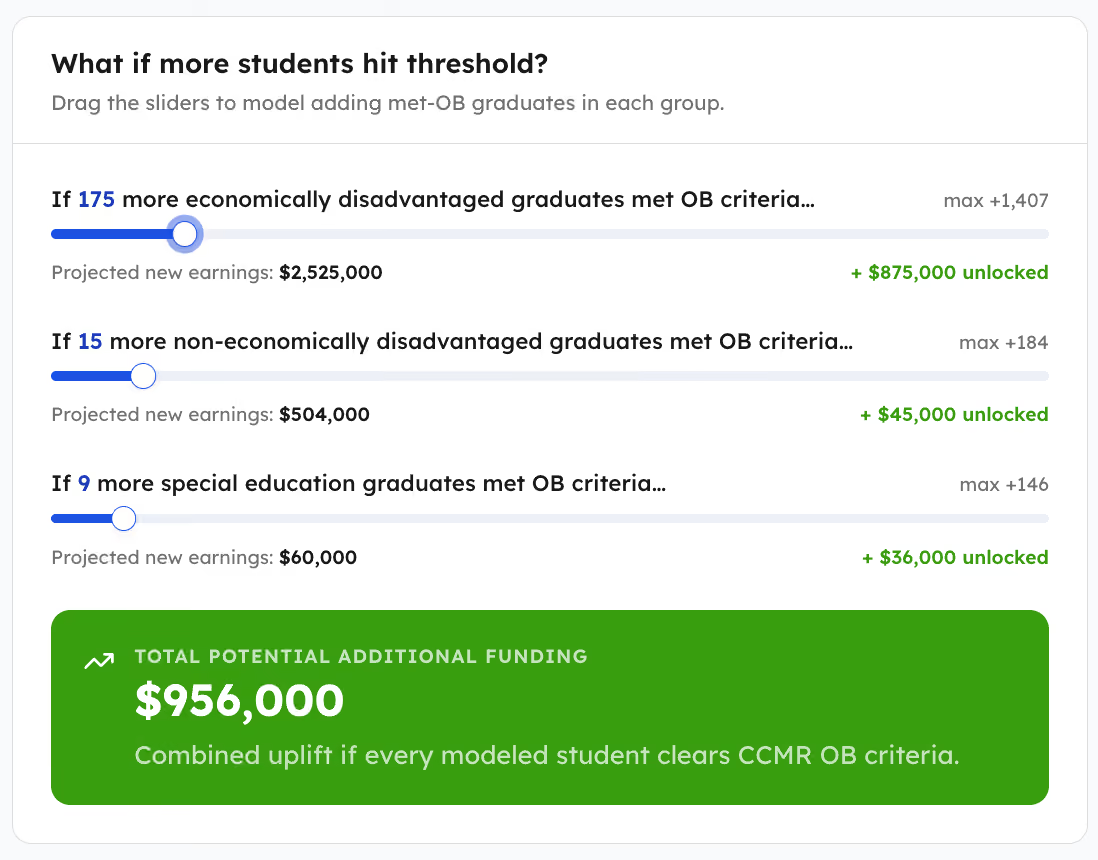
Sliders model new earnings from more graduates meeting OB criteria and total additional funding of $956,000.

Ensure Every Student is On-track

Summit Achieve doesn't just flag at-risk students — it tells you exactly what to do next and includes TSIA2 interventions to get them across the CCMR threshold before graduation.

Key Features

Blue letter A wearing a graduation cap with tassel on black background.
  • Auto-assigned, prescriptive interventions for every student
  • Built-in student-paced TSIA2 Prep for aligned to learning locator codes
  • CTE completer and IBC (Industry-Based Certification) tracking
  • Career pathway and program of study mapping per student
  • Counselor visibility into every student's real-time progress

Build Professional Capacity

Summit Achieve pairs its platform with structured professional development and expert-led strategy support. Together, they help your team identify opportunities, take action, and sustain CCMR improvement all year long.

The platform identifies opportunities. The CCMR Success Services ensure your team is empowered to act on them with year-round Professional Development.

PHASE 1
August-October
Foundational CCMR and Capacity Building

Leadership · Counselors · Coaches · Teachers

  • Baseline data audit
  • Master schedule alignment
  • Campus-wide CCMR ownership culture

PHASE 2
January - February

TSIA2 Intervention & Progress Check

Interventionists · Teachers · Coordinators

  • Real-time data tracking pipelines
  • Targeted student bootcamps
  • Specialized testing accommodations

PHASE 3
May - June

Reflection & Growth Planning

District Leaders · Principals · Teams

  • Accountability draft review
  • Next-year strategic planning
  • Professional growth goals

Frequently Asked Questions

What is Summit Achieve?

Summit Achieve is Summit K12's real-time college, career, and military readiness (CCMR) platform for Texas high schools and districts. It shows every student's CCMR status and Outcomes Bonus eligibility, prescribes interventions including TSIA2 prep, and tracks CTE completer status and industry-based certifications (IBCs). It's built for the Texas A–F accountability system, including the CCMR differential weighting that starts with the Class of 2030.

What is CCMR differential weighting, and when does it start?

Starting with 2031 A–F accountability ratings, which are based on the Class of 2030, Texas will stop counting every CCMR indicator equally. Under House Bill 8, each indicator's value is based on how strongly it correlates with students' success after high school. TEA groups indicators into three levels: Foundational, Demonstrated, and Advanced Postsecondary Readiness. A school's CCMR score is the average of three percentages: graduates at Foundational or above, at Demonstrated or above, and at Advanced.

What counts as Foundational, Demonstrated, and Advanced readiness?

Foundational readiness includes meeting TSI through an approved college prep course, passing one AP or IB exam, earning 3 hours of OnRamps or dual credit, or completing a CTE program with an aligned Tier 3 IBC. Demonstrated readiness includes meeting TSI on the TSIA2, SAT, or ACT, or completing a CTE program with an aligned Tier 2 IBC. Advanced readiness includes meeting TSI and earning college credit, earning an associate degree or a Level I or II certificate, completing a CTE program with an aligned Tier 1 IBC, or enlisting in the military.

How could differential weighting affect our A–F rating?

Schools whose graduates mostly qualify through Foundational indicators, such as a college prep course or a Tier 3 IBC, could see their CCMR score drop even if the same number of students meet CCMR. TEA says it will recalibrate cut points so overall rigor stays the same, but campuses that lean on lower-tier indicators will need more students reaching the Demonstrated and Advanced levels to hold their rating. Summit Achieve shows where each student sits on that scale today so that districts can be proactive rather than reactive about protecting their letter grade when those rules take effect in 2031.

What is the CCMR Outcomes Bonus?

The CCMR Outcomes Bonus is extra state funding Texas districts earn for graduates who are college, career, or military ready, above a minimum threshold set by TEA. Districts receive $5,000 for each qualifying economically disadvantaged graduate, $3,000 for each qualifying graduate who isn't economically disadvantaged, and $4,000 for each qualifying graduate in special education. The funding is paid the year after students graduate.

Do students need both TSIA2 and CTE to earn the Outcomes Bonus?

For the career-ready Outcomes Bonus, yes. A graduate must meet TSI college readiness criteria on the TSIA2, SAT, or ACT and earn an industry-based certification or a Level I or II certificate by August 31 after graduation. College-ready graduates must meet TSI criteria and enroll in college, or earn an associate degree. Military-ready graduates qualify by enlisting by December 31 after graduation. A CTE student with an IBC but no TSI score doesn't earn career-ready funding, so Summit Achieve flags students who have one piece but not the other.

How does Summit Achieve help students prepare for the TSIA2?

Summit Achieve identifies students who haven't yet met TSI criteria and facilitates the assignment of TSIA2 prep matched to each student's needs. Prep is delivered online, so students can work through it during the school day or at home, and staff track progress from the same dashboard they use for CCMR. Because meeting TSI is required for both the college-ready and career-ready Outcomes Bonus, TSIA2 prep is often the fastest way to move a student into a funded category.

How does Summit Achieve track CTE completers and industry-based certifications?

Summit Achieve tracks each student's CTE program of study, completer status, and industry-based certification (IBC) attainment across all four years of high school. Under differential weighting, a CTE completer with an aligned Tier 1 IBC counts at the Advanced level, while a Tier 3 IBC counts at Foundational, so the platform helps staff see which students are on track for higher-value pathways and which certifications still need to be logged.

Can Summit Achieve estimate our district's Outcomes Bonus funding?

Yes. Summit Achieve's Outcomes Bonus calculator models funding student by student, showing what your district has earned, what's still unclaimed, and how much more is possible if additional graduates meet college, career, or military readiness criteria. Leaders can connect specific interventions to projected funding and decide where to focus first.

Does Summit Achieve support Personal Graduation Plans?

Yes. Summit Achieve maps each student's Personal Graduation Plan (PGP) to their CTE program of study and collects digital signatures, so districts keep an audit trail of every plan and change. Counselors can see when a student's courses no longer line up with their pathway and adjust before it affects CCMR.

Who is Summit Achieve for?

Summit Achieve is built for Texas high school principals, counselors, CTE directors, and district leaders such as chief academic officers. District leaders see a districtwide rollup by graduating cohort and can drill down to campuses and individual students. Campus teams use the same data to plan interventions, log certifications, and keep graduation plans current.

When should districts start preparing for the Class of 2030?

Now. The Class of 2030 started high school in fall 2026, so their course, CTE, and testing choices over the next four years will determine their school's 2031 CCMR score. Districts that map each student's pathway early have time to move students from Foundational to Demonstrated or Advanced indicators, such as earning a TSI score or a higher-tier IBC, before graduation.