Scaffolding for Multilingual Learners: Five instructional shifts to help students engage with grade-level content
Five instructional shifts and five Access Moves help teachers give multilingual learners real access to grade-level work without doing the thinking for them.
By
Amelia Larson
Share this post
Table of contents
TL:DR: We may be giving students grade-level work, but are we ensuring they can do its thinking? TNTP's The Opportunity Myth found that students met assignment demands 71% of the time, yet demonstrated grade-level mastery only 17% of the time. The Opportunity Makers highlights schools that paired consistent grade-level instruction with support for engaging in it. This article offers five practical shifts and five Access Moves to help teachers start with the text and task, investigate the barrier, and adjust support based on student responses. The task remains central. Scaffolding should help students understand, reason, and communicate, not do the thinking for them.
The Same Task is Only the Starting Point
By Amelia Larson, Chief Academic Officer, Summit K12
In the Classroom
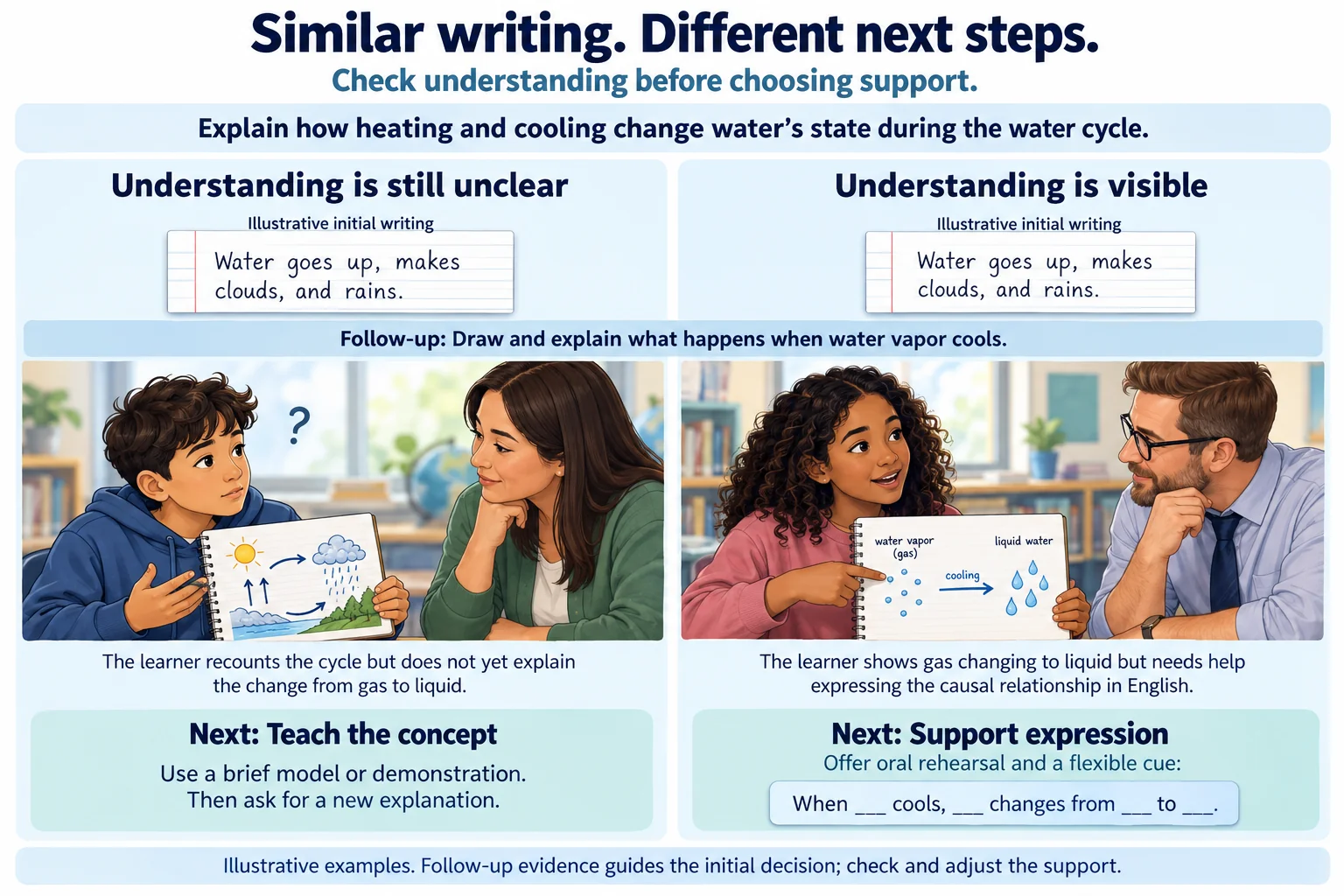
Two students receive the same science text, the same diagram, and the same task: Explain how heating and cooling change water during the water cycle.
One student describes evaporation and rain but does not explain changes in state. Another understands the changes and can show them in a drawing, yet struggles to express the causal relationships in English. Their written answers may look equally incomplete. Their next instructional steps should look different.
That distinction matters. Giving students the same task does not guarantee equal opportunity to the learning it offers. Access depends on what students can understand, investigate, discuss, and communicate—and on whether instruction helps them do that work themselves.
What the Research Reveals About Opportunity
The distinction between receiving a task and being able to engage with it matters beyond any one classroom. TNTP’s research asks us to examine both the work students receive and the instruction that helps them learn from it.
In The Opportunity Myth, students in the five school systems studied met the demands of their assignments 71% of the time, yet demonstrated mastery of grade-level standards on those same assignments only 17% of the time. Completing the work successfully often gave students little indication of the distance between what they had been asked to do and what grade-level learning required (TNTP, 2018).
The assignments themselves were part of the problem. Grade-appropriate work accounted for only 26% of students’ time on assignments; 74% of that time was spent on work that was not grade appropriate. This finding concerns the intellectual demands of the assignments, not simply the difficulty of their texts. The report also documented uneven access to strong instruction, deep engagement, and teachers’ high expectations. Students who began the year behind experienced stronger growth when they had greater access to grade-appropriate assignments (TNTP, 2018).
These findings raise an instructional challenge: students need worthwhile work, and they need opportunities to do its thinking. Providing challenging content is essential. What teachers ask students to investigate, discuss, and explain—and how they respond when students encounter difficulty—also matters.
The Opportunity Makers examines schools where students were making unusually strong progress. Among nearly 28,000 elementary and middle schools where the average student began below grade level, TNTP identified about 1,300 schools—roughly 5%—where students gained more than 1.3 years of learning per school year. In 23% of the schools analyzed, students gained less than a year of learning, widening the gap (TNTP, 2024, pp. 13–15).
TNTP then studied seven schools with unusually strong growth, ranging from 1.3 to 1.7 years of learning per year. Across different communities and school models, three commitments recurred: belonging, consistent grade-level instruction, and a coherent instructional program. Students worked with grade-level content and received additional support to engage with it when needed (TNTP, 2024, pp. 6–10).
The reports examine different samples and measures; they do not establish that a particular scaffold causes stronger outcomes. Together, however, they sharpen the responsibility: provide grade-level learning opportunities and respond to the barriers that prevent students from participating meaningfully.
That brings us to the question at the heart of this article: Are we giving students grade-level work—or ensuring they can engage with its ideas, do the thinking, and explain what they understand?
Start with the task, the source, and the learner
Before we ask which scaffold a student needs, we need to understand the learning the task makes possible. Read the source alongside the task. What ideas matter? How does the source communicate its meaning, and what will students need to say or write to show understanding? Here, “source” includes diagrams, data, images, and mathematical representations as well as written passages.
ELSF’s Must-Haves guidance argues that content and language should be planned together from the beginning. It identifies three priorities: mapping their development, monitoring both, and designing student collaboration and conversation (Castellanos, 2026). Its ELD Guidelines make the connection more specific: language objectives should address what students need to understand in a source and what they need to communicate about grade-level content (ELSF, n.d.-a, Guideline 2). In this article, those principles inform the analysis of the text and task before a support is chosen.
Content and reasoning. What knowledge must students use, and what relationships must they explain, compare, interpret, or justify? What evidence would show the required understanding?
Source language. Which words, sentence structures, text features, or connections between text and visuals carry essential meaning? Where might a learner lose the relationship between ideas, even when individual words are familiar?
Language for the task. What will students do with language? A request to explain a cause requires different language from a request to recount events. Identify useful language in the source and possible cues for the response; do not prescribe one sentence every student must reproduce.
Participation. How will students read or view, develop an idea, discuss it, and produce their own response? Which routines offer preparation, feedback, and revision? What relevant knowledge, home languages, and other resources can students bring?
In the water-cycle task, knowing the sequence is not enough. Students must connect heating and cooling to changes in state. A source may communicate those relationships through verbs, causal connectors, and diagram arrows. Teaching more sequencing words would miss the demand.
Bring in the learner. Compare these demands with an initial attempt and the student’s strengths. Knowing what students have already encountered helps teachers choose an initial support; their responses guide what happens next. WIDA’s Language for Learning guidance starts from learners’ assets and calls for meaningful opportunities to develop content understanding and language together. That stance directs our attention to what the learner already brings to the task (WIDA, n.d.).
An Instructional Decision Cycle for Choosing and Adjusting Support
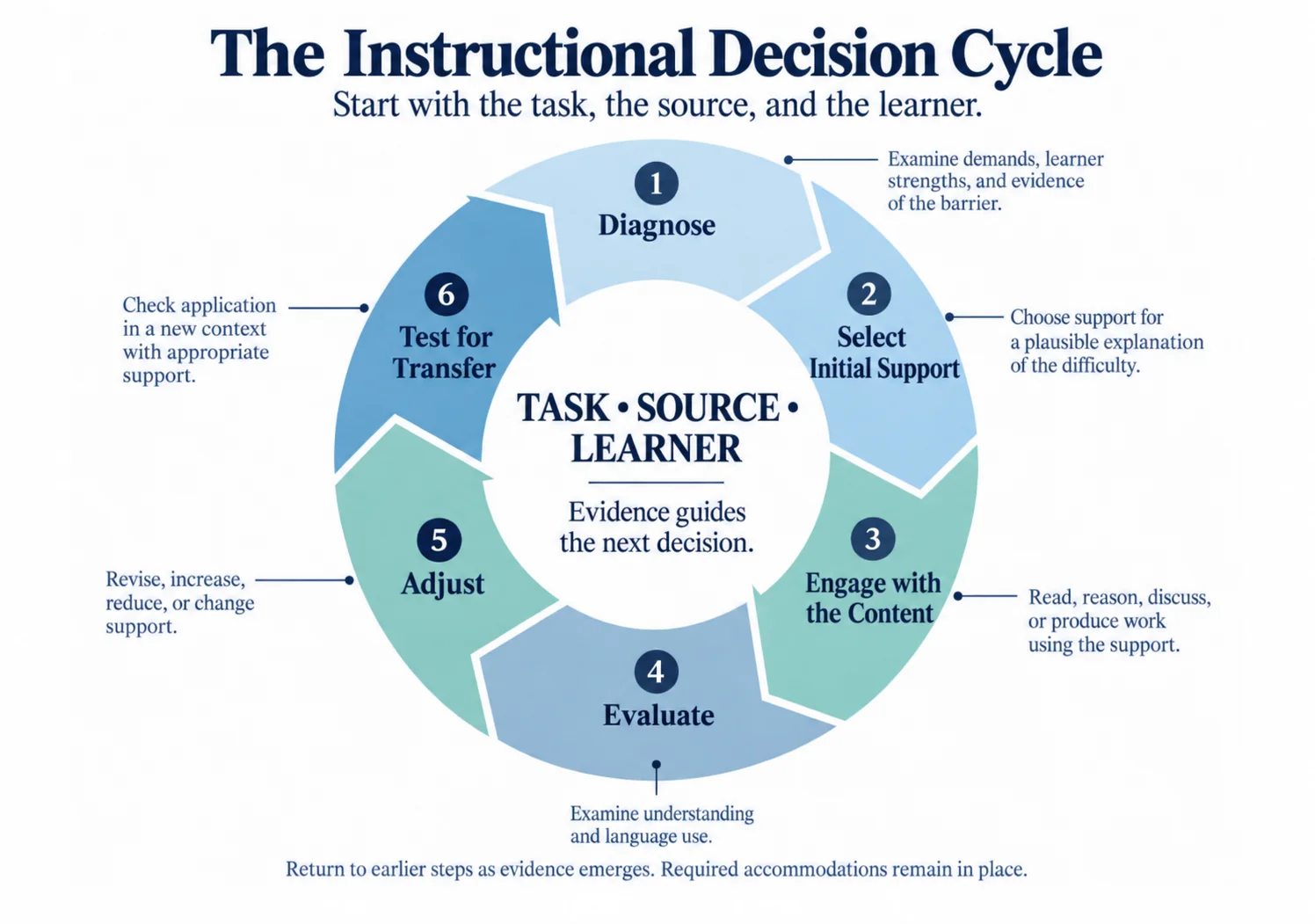
Examine an attempt, ask a question, or invite a drawing or oral explanation. Choose a support for a plausible barrier, then watch what happens when the student uses it. Revise, increase, reduce, or change the support according to the evidence. Return to earlier decisions whenever the response raises a new question. ELSF’s Guideline 13 calls for ongoing evidence from students’ spoken and written language to guide scaffolding decisions, rather than relying on annual proficiency scores or grades alone (ELSF, n.d.-a). The cycle turns that guidance into a sequence of instructional decisions; it is Summit’s organizing model.
Consider the opening science example. An illustrative student response—“Water goes up, makes clouds, and rains”—recounts the cycle without establishing understanding of changes in state. Ask the learner to draw and explain what happens when water vapor cools. If the explanation reveals confusion about gas and liquid, provide conceptual instruction using an accurate demonstration or model. If the learner shows the relationship but struggles to express it, offer an unfinished cue: “When ___ cools, it changes from ___ to ___.” The student supplies the scientific meaning.
A later question about droplets forming on a cold glass can help reveal whether the learner can apply the explanation in a new setting. A better response on the original task is useful evidence; transfer still needs its own check.
The Instructional Decision Cycle is iterative: Diagnose → Select Initial Support → Engage with the Content → Evaluate → Adjust → Test for Transfer. Text-and-task analysis informs the decisions throughout; it is not a separate checklist completed once.
Access Moves
Starting with the text, task, and learner, the instructional approach organizes task-connected language support around five opportunities within learning. The Instructional Decision Cycle guides the instructional choice; the Five Access Moves help locate where support may be useful. A teacher might plan for a demanding source before the lesson, then adjust support after hearing a student’s explanation. The moves are not proficiency levels, fixed student groups, or steps every learner must follow in order.
A: Connect to the Task
Help students understand what they are being asked to investigate, explain, or produce. Connect relevant knowledge and experience to the task and clarify what successful work requires. A learner who cannot begin may need the purpose made visible before needing more vocabulary. Read the prompt with the source in view: clarify the thinking required, the evidence students will use, and the form of the response. ELSF’s guidance on students’ assets asks teachers to build from knowledge and experiences developed at home and in the community. Here, those connections help the learner enter the task’s ideas (ELSF, n.d.-a, Guideline 10).
B: Access the Source
Help students make meaning from the text, diagram, data, problem, or other source. Supports might clarify a consequential phrase, connect labels to a visual, or guide attention to a relevant passage. Students still need opportunities to interpret the source and select evidence themselves. Analyze how this source carries meaning. A key phrase or a diagram relationship may need attention; explaining every unfamiliar word can distract from the ideas that matter. Berlin’s literacy guide recommends teaching academic language within grade-level texts and tasks, including meaning at the word, phrase, and sentence levels. That is the rationale for clarifying the language that carries this source’s meaning (Berlin, n.d., pp. 16–18).
C: Develop an Idea
Help students connect information to a claim, explanation, interpretation, or solution. A blank organizer or focused question can reveal whether they understand the relationship between evidence and reasoning. When that relationship is missing, instruction must address the thinking as well as its expression. Match the support to the relationship the task requires. A cause-and-effect organizer serves a different purpose from a comparison chart; choose according to the reasoning, then check the learner’s use. ELSF’s disciplinary-language guidance connects functions such as explaining and justifying to content learning. The support should help students express the relationship they are reasoning about (ELSF, n.d.-a, Guideline 2).
D: Discuss and Refine
Give students opportunities to explain, listen, question, and revise. Oral rehearsal should involve substantive ideas, not simply repeating a polished sentence. A partner’s question can help a learner recognize missing evidence or make an explanation more precise. Give listeners a purpose tied to the task, such as checking for source evidence or an explained relationship. ELSF’s interaction guidance calls for sustained exchanges and explicit teaching of conversation skills, including explaining, asking for clarification, and building on ideas (ELSF, n.d.-a, Guideline 5).
E: Show What You Know
Help students communicate their understanding in the form the task requires. A student may need a cue for explaining cause, comparing alternatives, or justifying a conclusion. Evaluate the content and language in the response, then examine what the learner can apply in another task. Evaluate against the original demands: is the explanation accurate, is the evidence relevant, and does the language make the reasoning clear? Notice these dimensions separately so feedback addresses the actual need. ELSF’s assessment guidance calls for clear content and language criteria, multiple ways to show learning, and actionable feedback followed by revision (ELSF, n.d.-a, Guidelines 12–13).
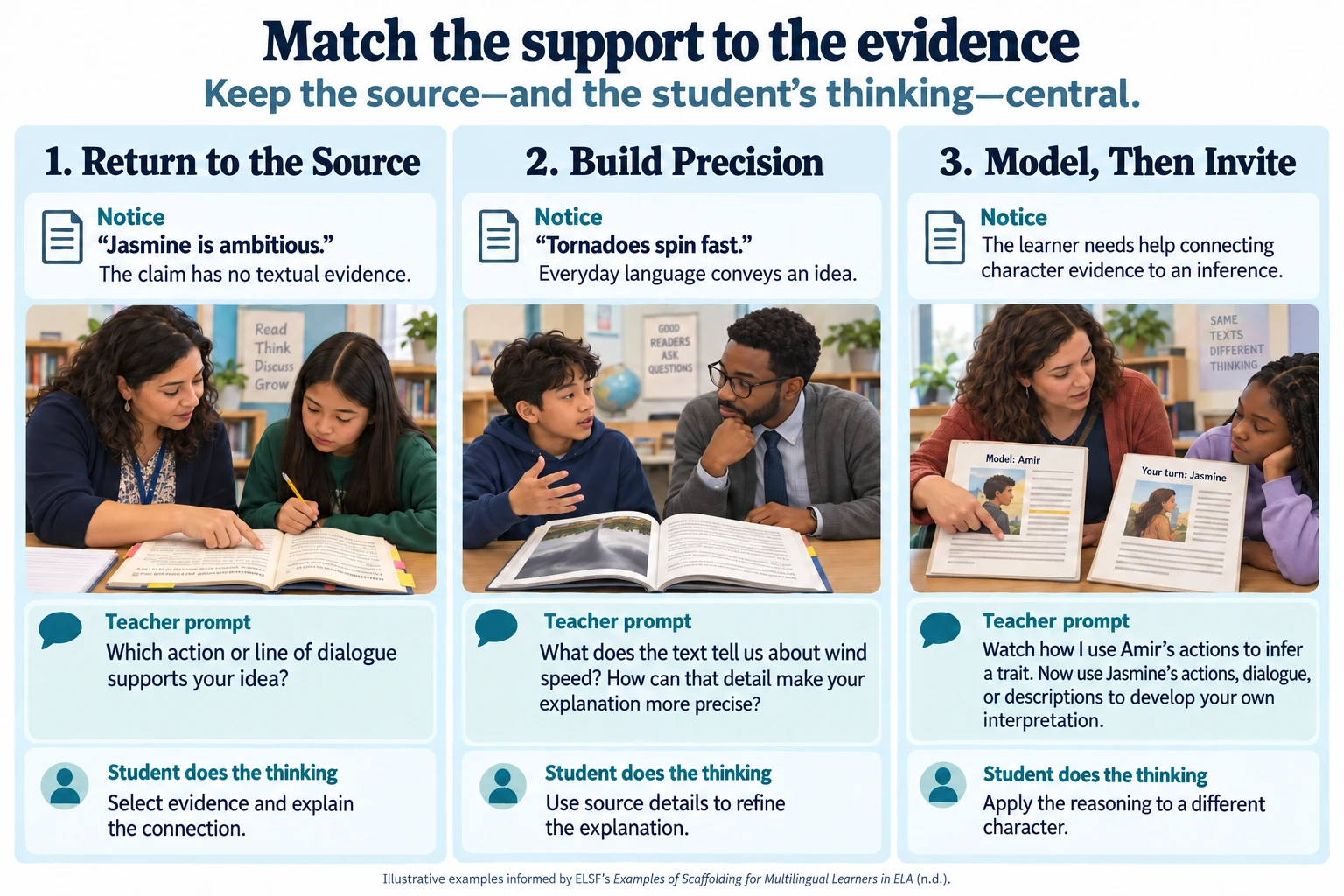
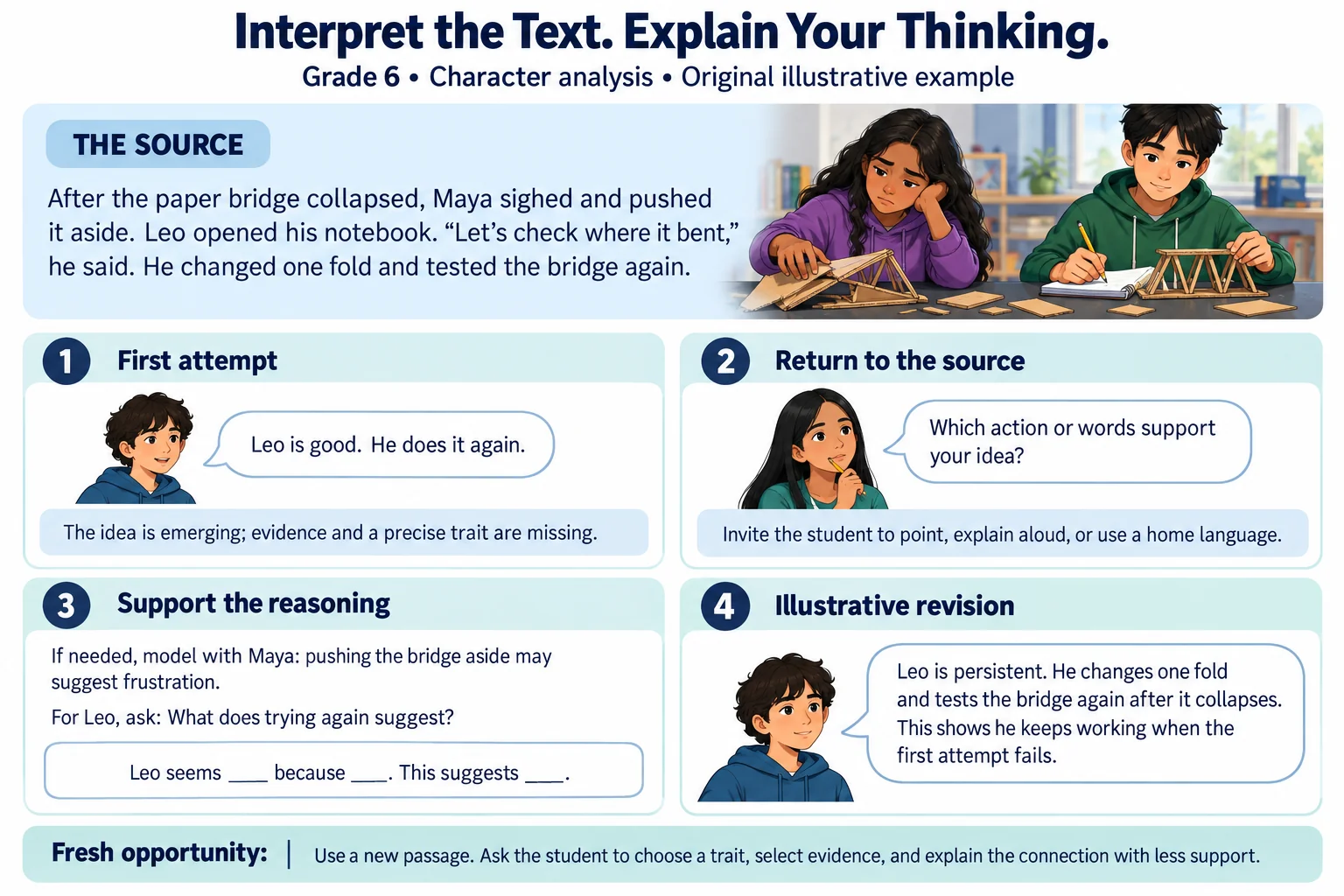
When a student offers a claim without textual support, return to the source; when everyday language conveys the idea, build toward more precise language grounded in the text. For example, after reading about a failed paper bridge, a student writes, “Leo is good. He does it again.” Ask the student to identify the action supporting that idea and explain what it suggests. If the reasoning remains unclear, model an inference about a different character—Maya’s sigh and decision to push the bridge aside may suggest frustration—then invite the student to analyze Leo independently. If the student understands Leo’s actions but needs help expressing the idea, offer an unfinished frame: “Leo seems ___ because ___. This suggests ___.” Follow with a new passage to see whether the student can select evidence and explain an inference with less support. The support responds to the student’s work; the student still does the thinking.
These are examples of matching support to evidence while preserving a fresh opportunity for student thinking. Using these moves responsively requires more than a repertoire of scaffolds. It requires five shifts in how we interpret student work and make instructional decisions.
Five shifts that make grade-level learning accessible
The five shifts put this task and source analysis into practice. They connect TNTP’s opportunity findings with WIDA’s emphasis on assets and integrated content and language learning, ELSF’s design guidance, and the literacy guide’s classroom practices. ELSF’s ELD Guidelines were developed for designated ELD materials; here, relevant principles inform support within disciplinary learning. The shifts are instructional commitments, not a tested intervention package.
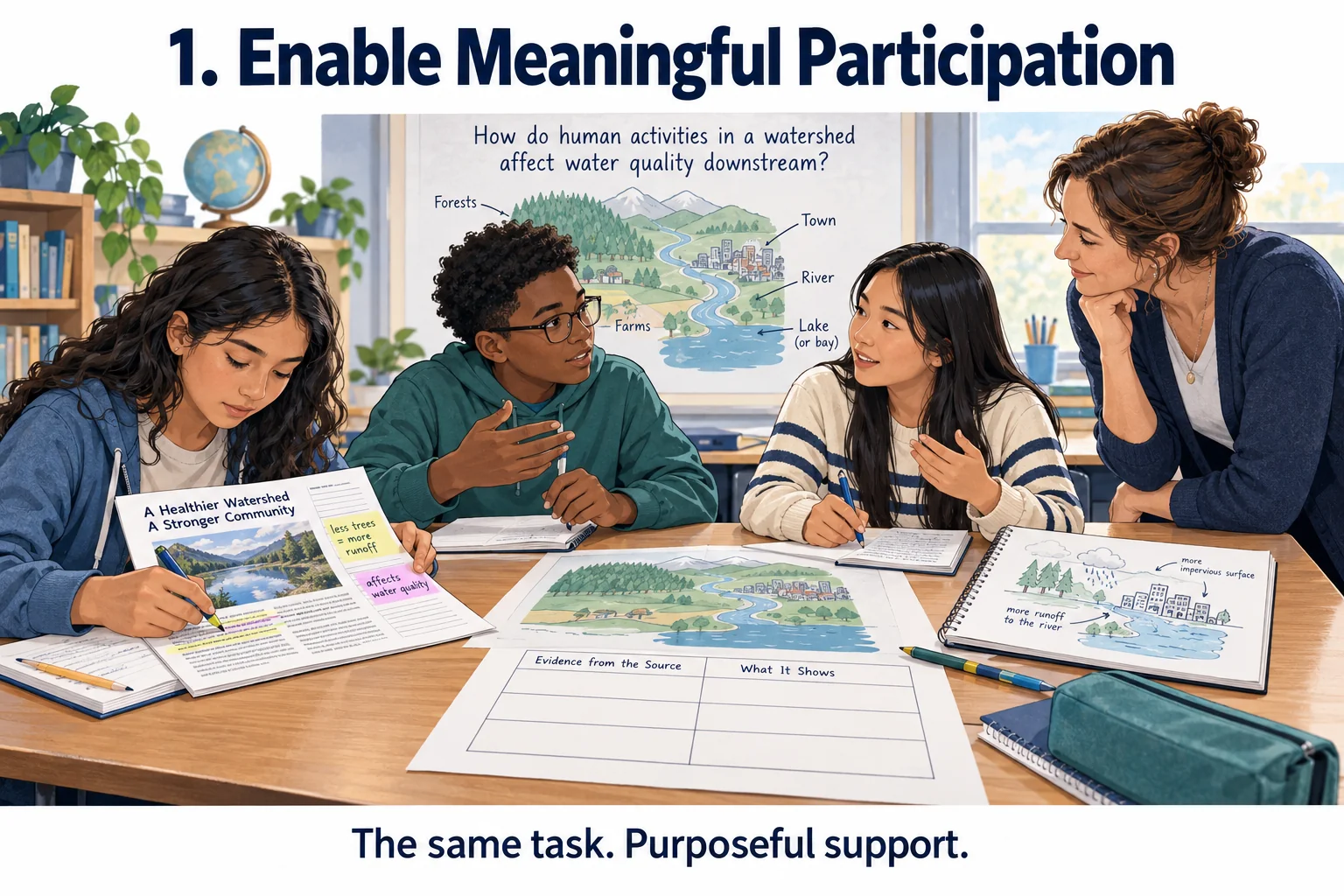
1. From assigning grade-level work to enabling meaningful participation
A student can sit in front of a complex source without having a meaningful opportunity to learn from it. Look beyond whether everyone has the same assignment. Can each learner interpret the source, investigate its ideas, contribute to discussion, and explain their reasoning? Keep the grade-level goal visible and create purposeful ways into the work. Belonging and high expectations become tangible through participation, not simply through an invitation to participate. TNTP’s reports make the opportunity problem visible. For classroom decisions, that means examining both the work offered and the participation instruction makes possible (TNTP, 2018; TNTP, 2024).
Look for: Can the student explain the task’s purpose, identify something relevant in the source, and contribute an idea? Notice who chooses evidence and makes connections—and who waits, copies, or relies on a partner to supply the reasoning. A quiet student may be thinking; a busy student may be completing steps without understanding. Ask for evidence rather than judging participation by appearances.
Use the evidence to decide the next move: If the learner cannot explain the goal, clarify the task. If the goal is clear but the source is confusing, investigate source access. If the student understands the source but cannot contribute during discussion, offer preparation time or oral rehearsal. Then check whether the learner can make a substantive contribution to the original task.
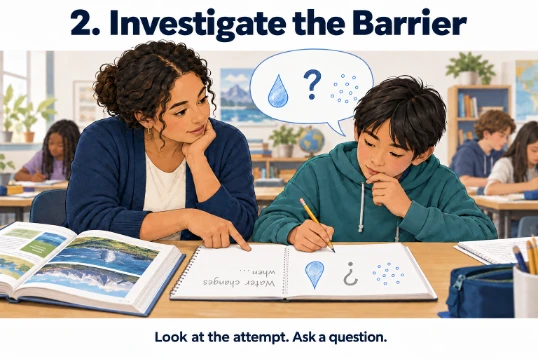
2. From matching support to proficiency labels to investigating the barrier
An incomplete answer is a reason to investigate. It may reflect a conceptual gap, difficulty accessing the source, uncertainty about the task, or a barrier to expressing an idea. Ask, “Show me what you understand so far.” Listen to an explanation, examine a drawing, or revisit a source passage together. English proficiency provides useful context; it cannot determine the support on its own. Choose a plausible next step, then check what the learner’s response reveals. A drawing can reveal thinking and open discussion; it should not become the learner’s only permitted response when the task also calls for substantive language use. ELSF’s Guideline 13 is explicit about using formative evidence to decide when scaffolds are needed. Proficiency information contributes to the decision; it does not replace an examination of this response to this task (ELSF, n.d.-a).
Look for: Compare what the student writes with what they can explain, draw, or show in the source. Does an oral explanation reveal a relationship missing from the writing? Does a drawing reveal a misconception? Can the learner explain a key passage in their own words? Where feasible, invite home-language meaning making. These probes provide clues; no single response establishes the cause with certainty.
Use the evidence to decide the next move: If the idea is clear across another mode, try support for expressing it in the required form. If understanding remains uncertain across modes, revisit the concept or source before adding a language frame. When several barriers interact, address the one preventing the next meaningful step and examine the response before adding more support.
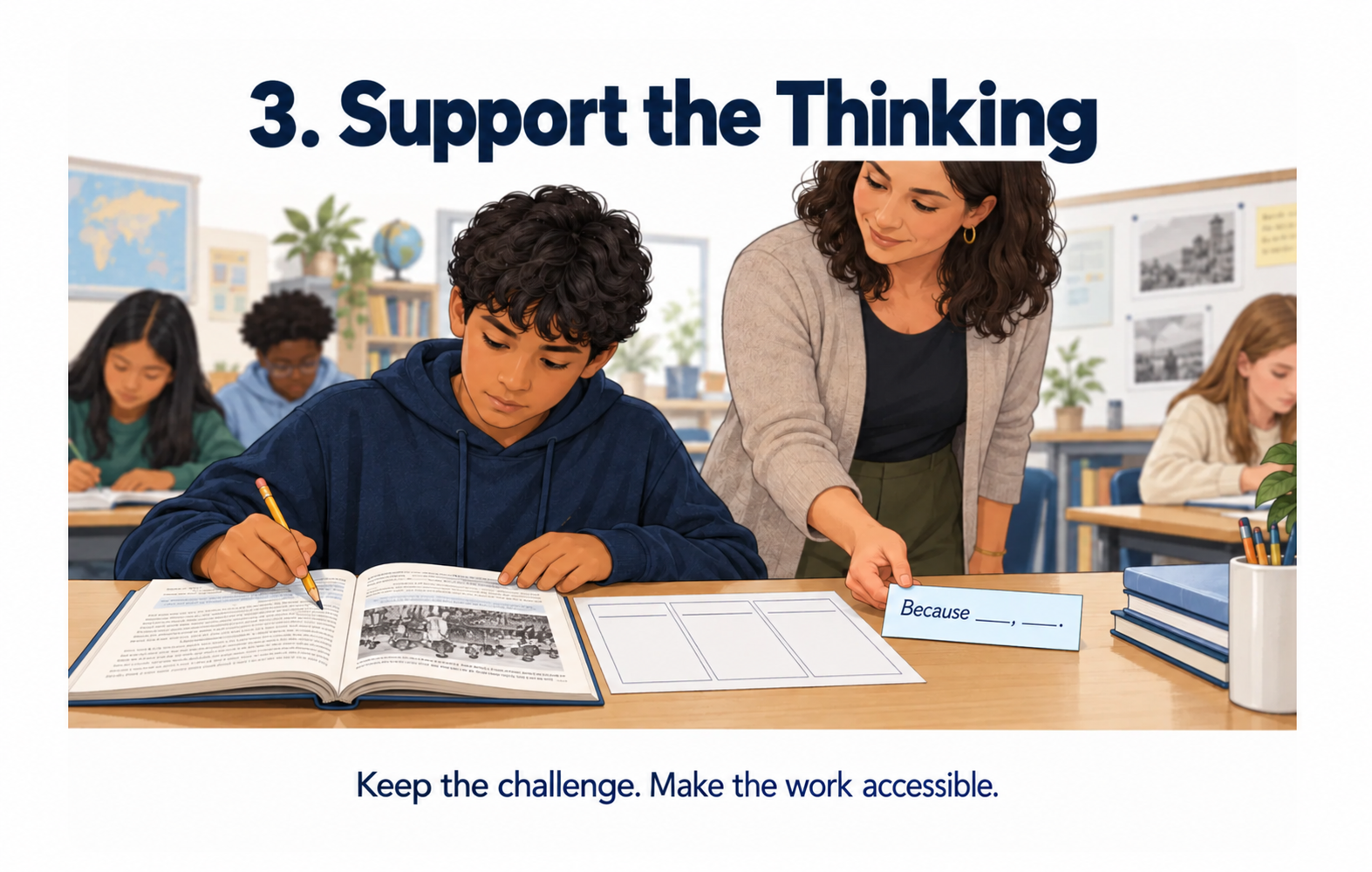
3. From simplifying the work to supporting the thinking
The task remains central. Clarify consequential language, annotate a source feature, or provide a blank organizer when those supports address the barrier. Keep the claim, evidence selection, and reasoning with the learner. A cue such as “Because ___, ___” can open space for explanation; a frame containing the explanation closes that space. When the concept itself is unclear, provide needed instruction before asking the learner to revise. Preserving the challenge does not mean withholding teaching. The issue is what the support asks students to do. ELSF’s guidance asks for differentiated supports that expand access and language use in service of knowledge building (ELSF, n.d.-a, Guideline 6). The classroom test is whether the support leaves students with meaningful thinking and language to produce.
Look for: After the support is offered, what does the learner still have to figure out? Look for students selecting evidence, explaining a connection, comparing alternatives, or justifying a choice. Check whether an organizer makes those relationships visible or has already supplied them. A completed sentence can conceal who contributed the idea.
Use the evidence to decide the next move: If a cue produces copying, replace it with an open prompt and ask the student to explain. If the learner can select evidence but cannot connect it to a claim, teach or model that reasoning with a comparable example, then return to the task. Keep necessary instructional modeling distinct from evidence of what the learner can do themselves.
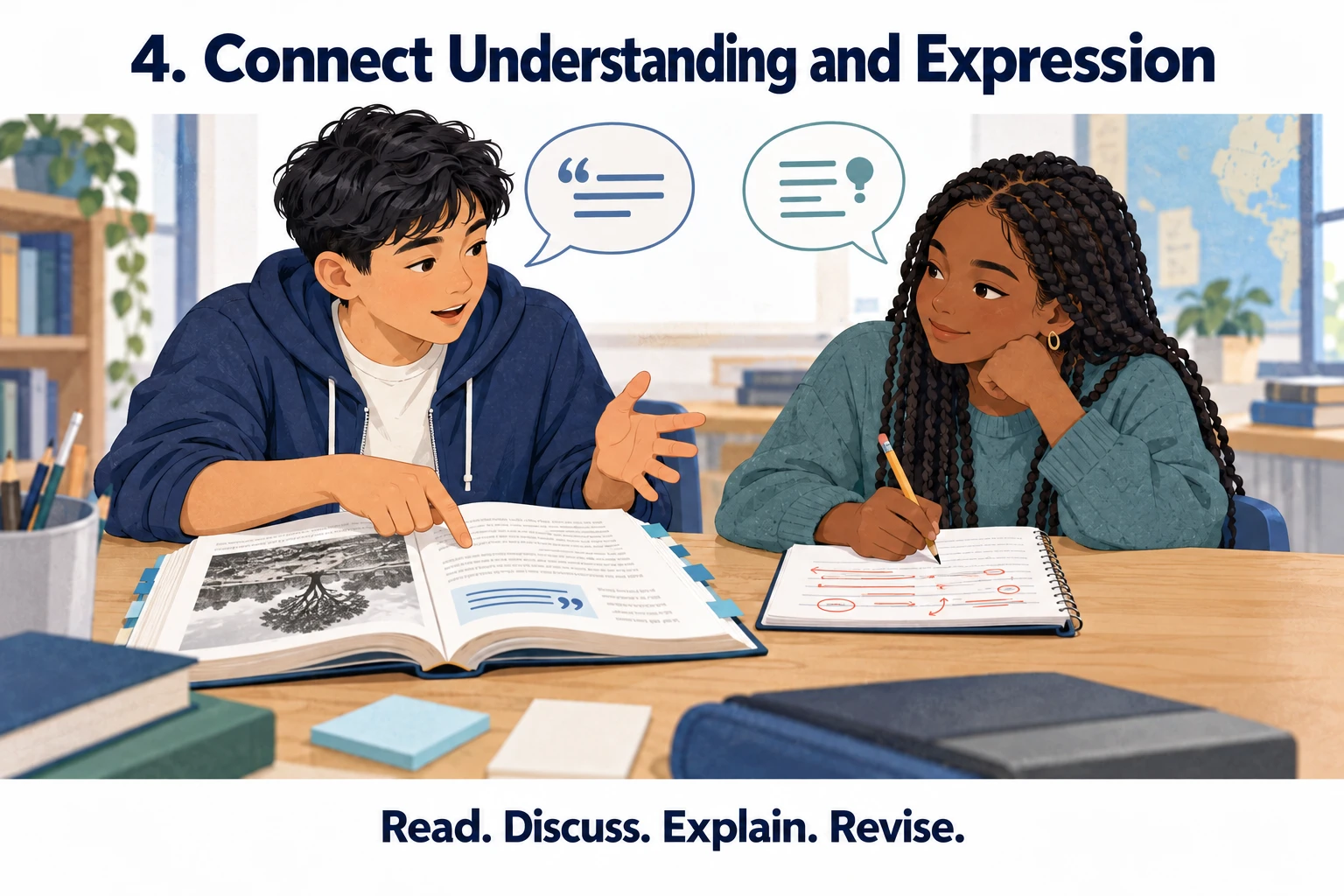
4. From supporting comprehension to developing ideas through language
Students develop understanding as they discuss, question, and refine ideas—not only before they communicate them. Design opportunities to read or view, discuss, rehearse, write, and revise around something worth thinking about. Make the task’s language functions explicit: explain a cause, compare interpretations, or justify a solution. Home languages, drawings, and other modalities can support meaning making. Use them as resources while providing opportunities to develop the language the disciplinary task requires. ELSF connects reading and writing with discussion and repeated opportunities to refine language (ELSF, n.d.-a, Guideline 1). Berlin’s guide makes the instructional requirement concrete: teach the relevant language, provide structured speaking and listening practice, and give feedback students can use on another attempt (Berlin, n.d., pp. 26–34). WIDA situates these opportunities within the simultaneous development of content understanding and language (WIDA, n.d.).
Look for: Listen for the language function the task requires. Is the student explaining why, or only naming what happened? Comparing ideas, or describing each separately? Justifying a solution, or reporting an answer? Notice whether discussion adds evidence or precision to the student’s next attempt. Longer speech or writing alone does not establish stronger reasoning.
Use the evidence to decide the next move: If the idea is sound but the relationship is hard to express, offer a focused cue and rehearsal—for example, “Both ___, but ___” for comparison. If the student has no idea to express, return to the source or concept. After rehearsal, ask for an individual response so each learner has an opportunity to communicate and revise their own understanding.
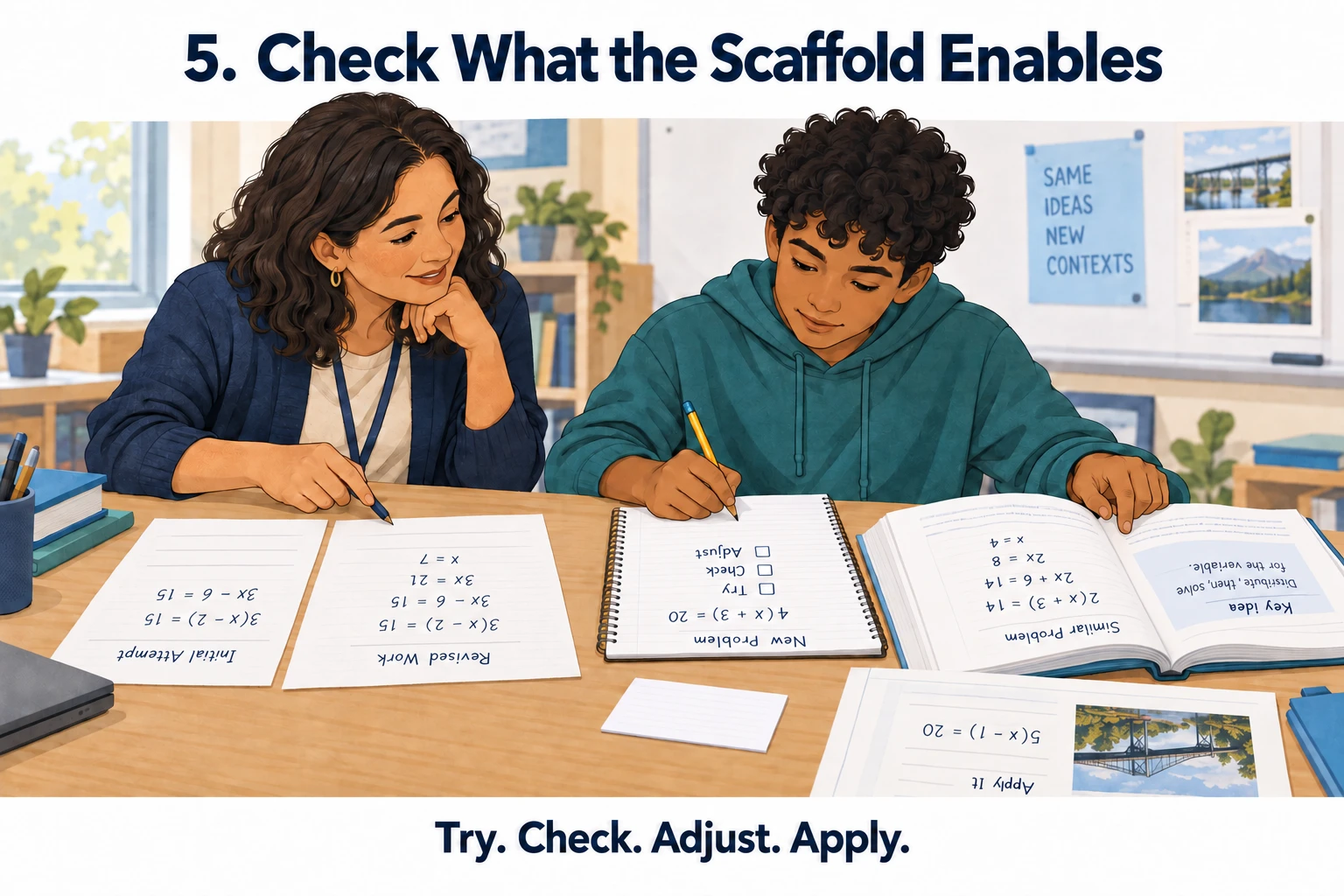
5. From providing a scaffold to checking what it enables
A completed organizer or polished response does not tell us enough. Ask what the student understood, contributed, and can explain. Compare the attempt with the revised work, then adjust the support. Reduce an optional cue when evidence supports doing so; restore or change it when needed. Required accommodations remain in place. Finally, examine application in a new context. Independence and transfer need evidence of their own. This follows the monitoring priority in ELSF’s Must-Haves: evidence of content and language development should shape teaching and learning decisions (Castellanos, 2026). A scaffold is a means of supporting that learning, not the outcome to count.
Look for: Compare the first attempt, the support used, and the revised response. Can the student explain why the evidence fits? What happens when an optional cue is reduced? On a new task, can the learner recognize the relevant relationship and apply it? Notice dependence on a particular prompt as well as gains in understanding, language, and participation.
Use the evidence to decide the next move: Continue support when it enables meaningful thinking. Reduce an optional scaffold gradually when the learner shows readiness; restore or change it if the next attempt reveals difficulty. Keep required accommodations. Record a specific next check, such as “On the next source, can the student choose evidence and explain its relevance?” A stronger response today guides tomorrow’s decision; it does not establish transfer by itself.
The research and guidance inform the instructional design of Summit Sidekick; they do not establish its effectiveness. Claims about outcomes require product-specific evaluation.
Make the Next Instructional Decision Count
Giving students the same task is a starting point. What matters next is whether they can engage with its ideas, do the thinking, and communicate what they understand.
Start with one upcoming lesson. Examine the text and task. Identify the content, reasoning, and language students will need. Then look closely at an initial attempt, choose a support for a plausible barrier, and check what it enables. Adjust—and return to the learning in a new context.
Before adding another scaffold, ask: What is this student trying to understand or express—and what support will help them do that work themselves?