The Next Frontier in Multilingual Literacy: Designing Coherent Systems
Three studies find multilingual learners gain more in language, reading, and achievement when literacy and implementation work as one coherent system.

Three studies find multilingual learners gain more in language, reading, and achievement when literacy and implementation work as one coherent system.
For decades, efforts to improve education have centered on finding better instructional practices. The Science of Reading sharpened our understanding of how students learn to read. Research on multilingual learners has shown that language, literacy, and academic learning develop together through reading, writing, speaking, and listening in meaningful content. Implementation science adds another important lesson: even strong, evidence-based practices produce uneven results when the systems around them are fragmented.
Each of these research traditions has reshaped education in important ways. Taken together, they point toward what may be the next frontier in multilingual literacy.
That distinction matters. Districts often design curriculum, language development, assessment, professional learning, coaching, leadership, and continuous improvement as separate initiatives. Students do not experience them that way. In the classroom, those pieces come together as one instructional experience.
The field already has substantial evidence about effective literacy instruction, language development, and implementation. The harder question now is how to put that evidence together so the parts reinforce, rather than compete with, one another.
This article introduces the Integrated Multilingual Literacy Framework, a conceptual model that synthesizes insights from the Science of Reading, multilingual learner research, and implementation science into a unified systems approach for multilingual learners. It then examines evidence from three large-scale independent efficacy studies to explore whether districts implementing an integrated multilingual literacy system demonstrated stronger outcomes in English language proficiency, reading growth, and academic achievement.
Instead of presenting three independent evaluations, this article argues that they represent three complementary tests of a single proposition: when literacy, language development, and implementation operate as one coherent instructional system, multilingual learners experience stronger outcomes across language proficiency, reading growth, and academic achievement.
The Science of Reading, multilingual learner research, and implementation science each explain a different part of the same challenge: how students learn, how language and literacy develop together, and how strong practices become sustained classroom instruction. What remains less developed is a framework that connects these bodies of evidence into one coherent system.
The Integrated Multilingual Literacy Framework offers one way to address that challenge. It is not a new theory of reading or language development. Instead, it brings established evidence together in a model that aligns literacy instruction, language development, assessment, educator learning, leadership, and continuous improvement. This article develops the rationale for the framework and then looks at three complementary efficacy studies to ask a practical question: Are student outcomes stronger when literacy, language, and implementation work as one coherent instructional system?
Three major bodies of research have reshaped our understanding of effective instruction. They emerged from different disciplines and asked different questions, but their findings are increasingly converging.
The Science of Reading asked one of the field's most enduring questions: How do children learn to read? Drawing from cognitive psychology, linguistics, neuroscience, and education, this body of evidence established that skilled reading depends on far more than exposure to text. It identified the essential cognitive and linguistic processes underlying successful reading—including phonological awareness, decoding, word recognition, fluency, vocabulary, language comprehension, and knowledge building—and demonstrated the importance of explicit, systematic instruction in developing these competencies (Castles et al., 2018; Ehri, 2020; National Reading Panel, 2000). More recently, reading research has moved beyond identifying these components to understanding how they interact dynamically during comprehension and meaning making.
At the same time, multilingual learner research addressed a different question: How do students develop literacy while simultaneously acquiring an additional language? Researchers in bilingualism, second-language acquisition, and multilingual education demonstrated that language development, literacy, conceptual understanding, and academic learning evolve reciprocally rather than sequentially. This scholarship challenged deficit-oriented views of multilingualism by showing that students' existing linguistic knowledge serves as a resource for learning and that reading, writing, speaking, listening, vocabulary development, and knowledge building continually reinforce one another throughout the learning process (August & Shanahan, 2006; Cummins, 1979, 2000; García & Kleifgen, 2018; Goldenberg, 2020).
A third body of scholarship, implementation science, approached the challenge from an organizational perspective by asking: Why do evidence-based instructional practices succeed in some schools but fail to produce similar results in others? Instead of focusing on individual instructional strategies, implementation science examined the conditions required for sustainable improvement. Across education and other human-service fields, researchers consistently found that effective practices alone are insufficient. Lasting improvement depends upon coherent systems that align curriculum, assessment, professional learning, instructional coaching, leadership, and continuous improvement around shared instructional goals (Bryk et al., 2015; Fixsen et al., 2005; Fullan, 2020).
Historically, these three traditions developed along separate trajectories. Literacy researchers focused on the cognitive architecture of reading. Multilingual learner researchers examined the interaction of language, literacy, identity, and academic learning. Implementation scientists investigated how organizations translate research into consistent classroom practice. Because they asked different questions, their findings were often interpreted independently.
Increasingly, however, the boundaries among these traditions have begun to dissolve.
Taken together, they suggest that educational improvement depends not simply on identifying effective instructional components but on understanding how those components function together within coherent systems. Reading develops through the coordination of multiple cognitive and linguistic processes. Language proficiency develops through meaningful participation in literacy and academic learning. Evidence-based practices produce sustained improvement only when curriculum, assessment, educator learning, leadership, and continuous improvement operate in alignment. Although each tradition contributes a different perspective, they increasingly point toward the same conclusion: the quality of the connections among instructional processes is as important as the quality of the individual components themselves.
Taken together, these traditions suggest that the next major advances in multilingual literacy may not come from adding another evidence-based practice. The bigger opportunity is to connect what we already know in ways that allow strong practices to work together.
The evolution of reading theory reflects the broader movement described in the previous section. As literacy research has matured, successive theoretical models have progressively refined our understanding of skilled reading. Instead of replacing earlier frameworks, each has extended the field's knowledge by explaining additional dimensions of the reading process. Taken together, these models illustrate an important shift—from identifying the essential components of reading to understanding how those components interact during authentic literacy experiences.
The Simple View of Reading established that successful reading comprehension depends upon the interaction of two essential competencies: word recognition and language comprehension (Gough & Tunmer, 1986; Hoover & Gough, 1990). Its enduring contribution was demonstrating that neither accurate decoding nor language comprehension alone is sufficient for successful reading. Students must be able to recognize printed words accurately while also understanding the language those words convey. By resolving earlier debates that often positioned decoding and comprehension as competing priorities, the Simple View provided a foundational architecture that continues to influence literacy research and instructional practice.
Building upon this foundation, Scarborough's Reading Rope (2001) expanded the field's understanding by illustrating that each of these broad domains consists of multiple interacting strands that become increasingly coordinated through instruction and experience. The word-recognition strands include phonological awareness, decoding, and automatic word recognition, while the language-comprehension strands encompass background knowledge, vocabulary, language structures, verbal reasoning, and literacy knowledge. As these strands become increasingly strategic, fluent, and interconnected, skilled reading emerges. Scarborough's contribution was to demonstrate that literacy develops not through isolated skills but through the gradual coordination of multiple cognitive and linguistic processes.
More recently, the Active View of Reading has further advanced this progression by emphasizing that skilled reading is an active process requiring readers to coordinate far more than word recognition and language comprehension alone (Duke & Cartwright, 2021). The model highlights the roles of motivation, engagement, executive functioning, self-regulation, and, importantly, bridging processes that connect word recognition with comprehension. Vocabulary, fluency, morphological awareness, comprehension monitoring, and other bridging processes enable readers to integrate decoding, language, and knowledge while constructing meaning from increasingly complex text. Instead of functioning as independent instructional targets, these processes work together dynamically during reading.
Recent classroom research suggests that these bridging processes represent an important opportunity for strengthening literacy instruction. Observations across elementary classrooms indicate that while explicit instruction in foundational reading skills has become increasingly common, instructional opportunities that intentionally connect decoding with vocabulary development, oral language, connected-text reading, and comprehension occur less consistently. Jennerjohn and colleagues (2026) argue that strengthening these instructional connections may help students move more effectively from accurate word recognition toward deep comprehension, particularly when reading increasingly complex texts.
Taken together, these theoretical developments reveal an important evolution in literacy research. The field has progressed from identifying the essential components of reading, to explaining how those components interact, to recognizing the bridging processes and active regulation that enable readers to coordinate them during authentic reading. Increasingly, the central question is no longer simply what develops skilled reading, but how those processes work together to construct meaning.
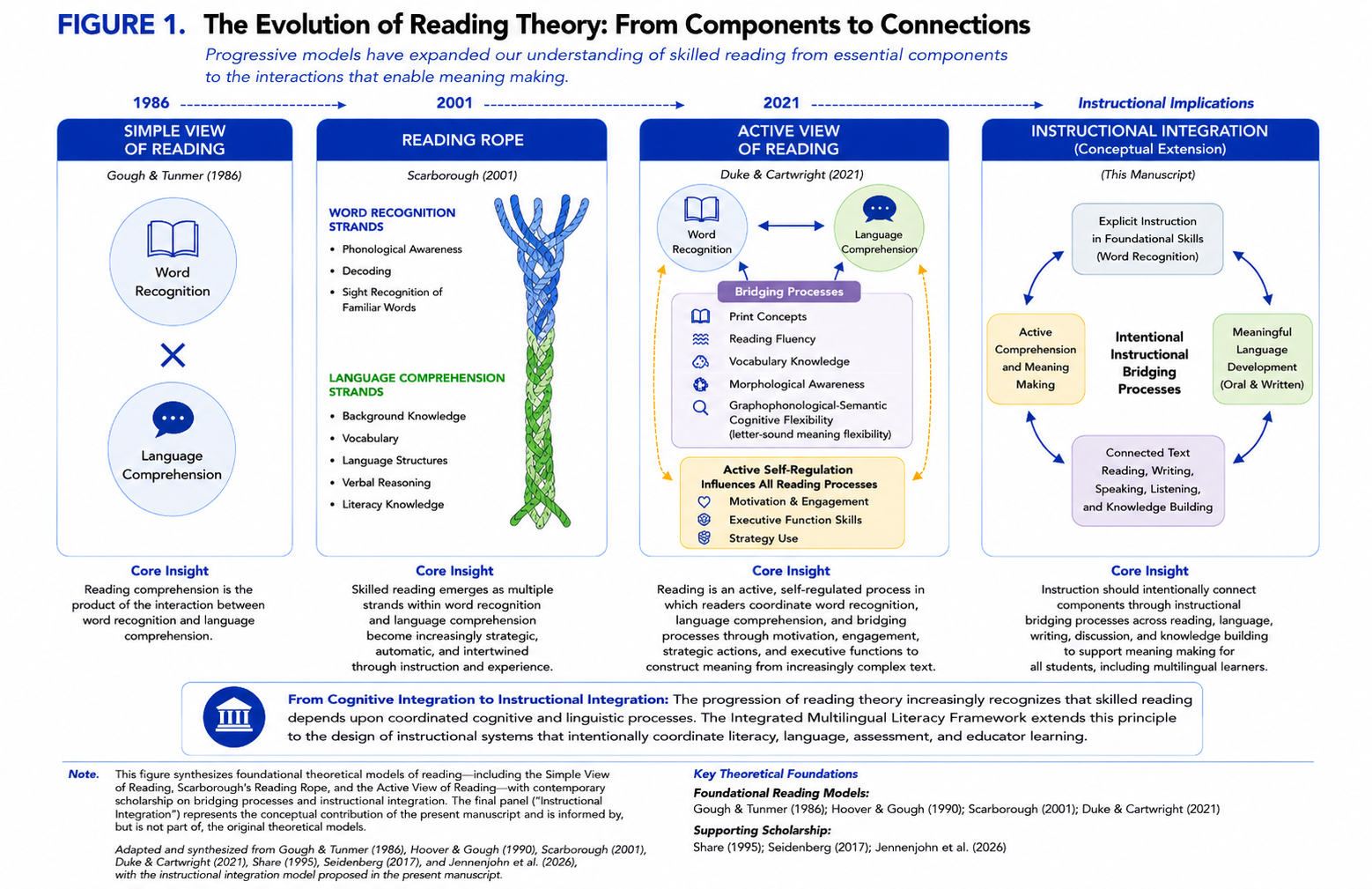
Major reading frameworks increasingly emphasize coordination among cognitive and linguistic processes. The Integrated Multilingual Literacy Framework extends that idea from the reader to the instructional system.
This theoretical evolution raises an important question. If successful reading depends upon the coordinated interaction of multiple cognitive and linguistic processes, how should instructional systems be intentionally designed to cultivate those same interactions for students who are simultaneously developing literacy and acquiring an additional language?
For multilingual learners, these interactions are especially consequential because literacy development occurs simultaneously with English language development, vocabulary acquisition, knowledge building, and academic learning. Students are not progressing through these domains in isolation; they are developing them concurrently while drawing upon linguistic resources across languages. Decades of multilingual learner research consistently demonstrate that growth in one domain strengthens learning in others. Reading expands vocabulary. Academic conversations deepen comprehension. Writing reinforces language structures. Knowledge building enhances reading comprehension. These reciprocal relationships suggest that literacy and language development should not be organized as separate educational priorities but as mutually reinforcing dimensions of learning.
This perspective does not compete with contemporary reading research; it builds on it. Effective instruction requires explicit teaching of foundational skills and meaningful opportunities to develop language, build knowledge, engage in academic discourse, and use literacy in authentic learning. The question is not whether these elements matter. It is how schools organize them so they work together in daily instruction.
The convergence of these research traditions raises a broader organizational question. If skilled reading depends upon the coordination of multiple cognitive and linguistic processes, and multilingual learners develop language and literacy through reciprocal interactions, how should schools organize curriculum, assessment, professional learning, coaching, leadership, and continuous improvement to support those interactions consistently across classrooms?
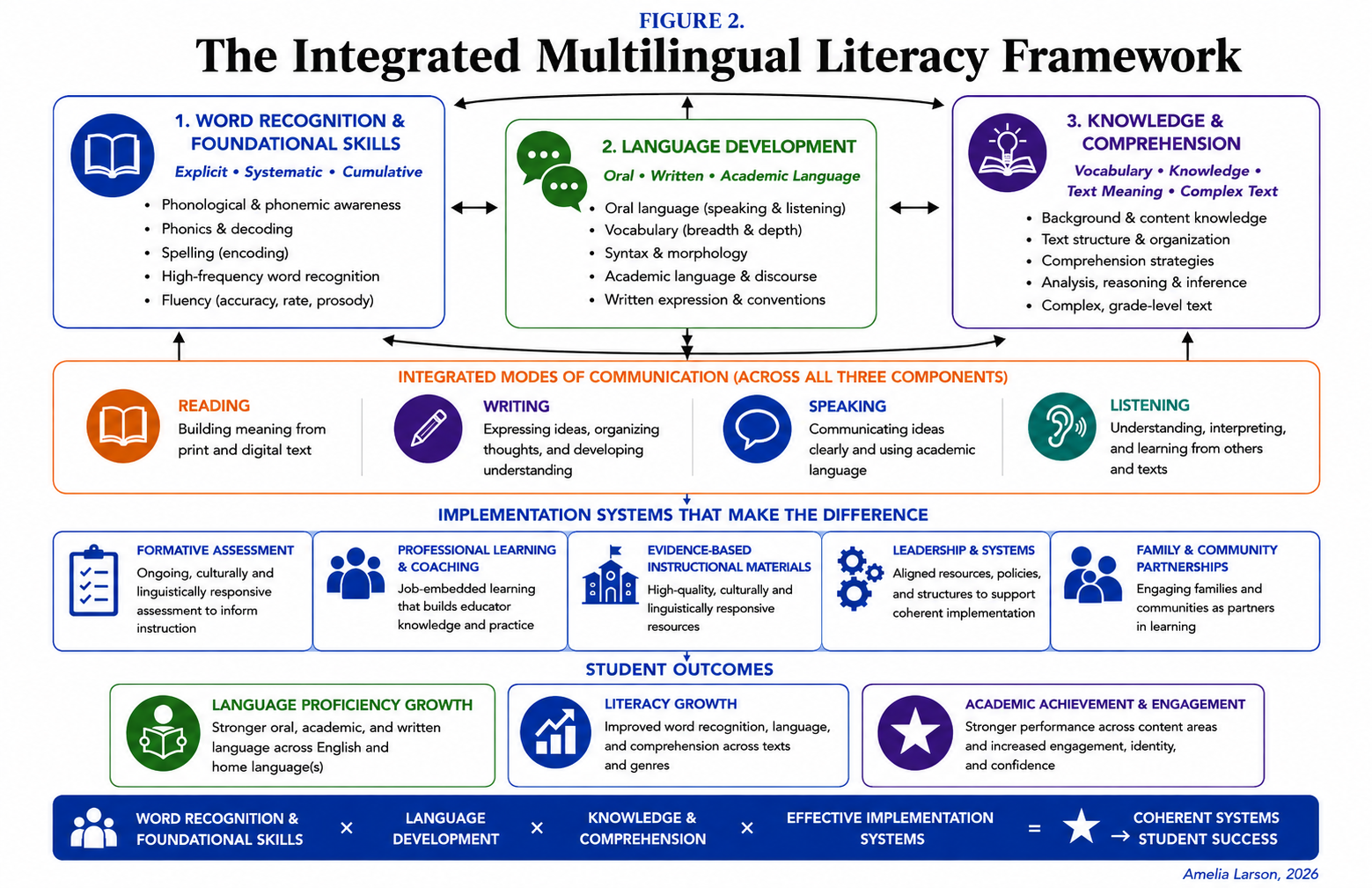
The Integrated Multilingual Literacy Framework proposed here responds to that question. Figure 2 synthesizes the preceding theoretical discussion into the Integrated Multilingual Literacy Framework. Instead of introducing a new theory of reading, language development, or implementation, the framework integrates these established bodies of evidence into a single organizational model. Its central proposition is that instructional systems should intentionally mirror what contemporary reading theory tells us about learning itself. Just as skilled reading depends upon coordinated interactions among multiple cognitive and linguistic processes, effective educational systems should intentionally coordinate literacy instruction, language development, assessment, educator learning, leadership, and continuous improvement so that each reinforces the others.
That proposition leads to an empirical question: Do students experience stronger outcomes in systems organized around these principles? Three complementary efficacy studies provide an opportunity to examine the pattern across English language proficiency, reading growth, and academic achievement.
Three complementary efficacy studies examined multilingual learner outcomes across indicators of English language proficiency, reading growth, and academic achievement. English language proficiency was measured using the Texas English Language Proficiency Assessment System (TELPAS). Reading growth was examined using the NWEA Measures of Academic Progress Reading assessment. Academic achievement was evaluated using the State of Texas Assessments of Academic Readiness Reading assessment.
The measures answer different questions. TELPAS captures academic English development across listening, speaking, reading, and writing. MAP Reading measures growth relative to projected progress. STAAR Reading measures performance against grade-level standards. Together, they provide a broader view of language proficiency, literacy growth, and academic achievement.
Each study used a rigorous quasi-experimental design with propensity score matching to create treatment and comparison groups that were similar on measured baseline characteristics. The evaluations took place under real district implementation conditions, which makes the findings especially relevant to practice. Together, the studies provide evidence consistent with ESSA Tier II requirements. Still, these are quasi-experimental studies. The results show strong associations, not definitive proof of causation.
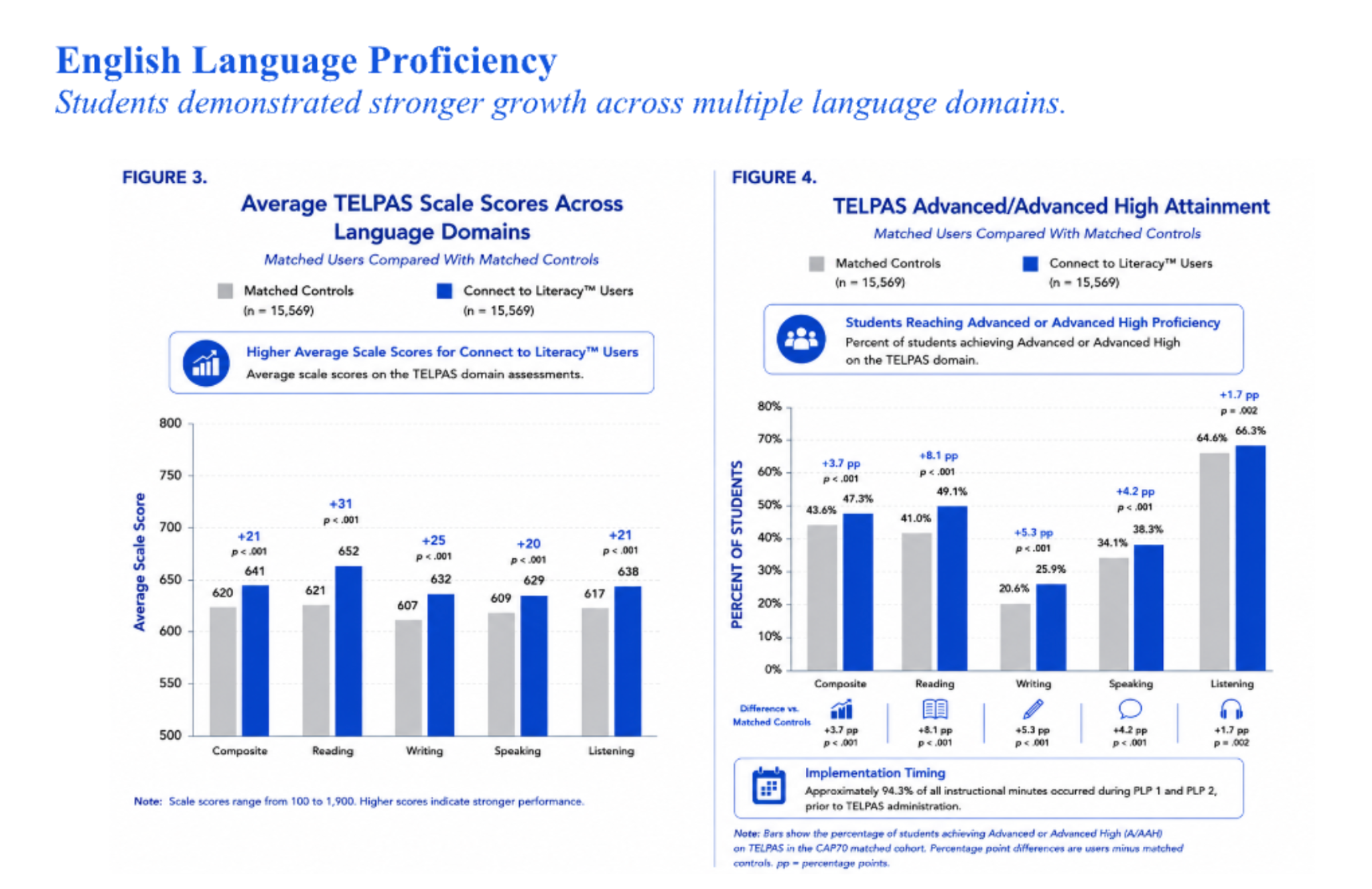
The first study examined English language proficiency using TELPAS. Students participating in Connect to Literacy’s integrated multilingual literacy system achieved higher average scale scores than matched comparison students across every reported TELPAS domain. The largest scale-score differences were observed in Reading, with a 31-point advantage, and Writing, with a 25-point advantage.
The findings were also positive when examining attainment of the state’s upper proficiency levels. Compared with matched non-users, Connect to Literacy participants were 3.7 percentage points more likely to achieve Advanced or Advanced High proficiency on the TELPAS Composite assessment. The largest differences were observed in Reading, at +8.1 percentage points, followed by Writing, at +5.4 percentage points, and Speaking, at +4.2 percentage points. Statistically significant advantages were reported across every domain examined, and positive patterns were evident across nearly every student group and instructional setting included in the study.
These findings fit a central principle of multilingual literacy instruction: academic language develops through meaningful reading, writing, discussion, and knowledge building. The study cannot show that literacy experiences alone caused the language gains. It does suggest, however, that language development may be stronger when it is woven into sustained literacy and academic learning rather than treated only as a separate activity.
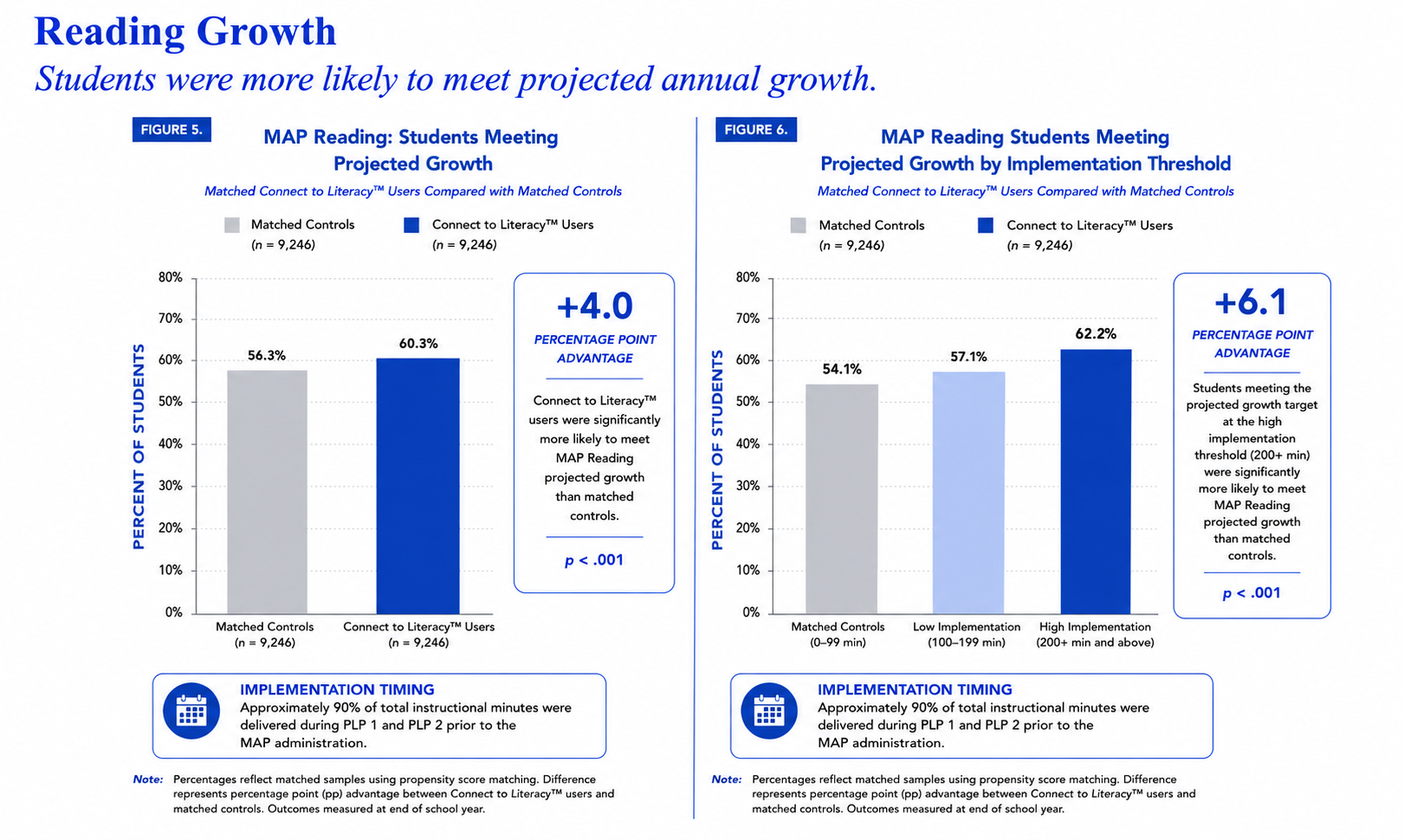
The second study examined reading growth using the NWEA MAP Reading assessment. Students participating in the integrated multilingual literacy system were significantly more likely to meet their projected annual reading growth targets than carefully matched comparison students: 60.5% compared with 56.5%, a difference of 4.0 percentage points (OR = 1.18, p < .001).
Students in the highest implementation group demonstrated the strongest outcomes. Among these students, 62.2% met projected growth compared with 56.1% of matched non-users, representing a 6.1-percentage-point difference (p < .001). This pattern suggests that stronger implementation was associated with stronger reading outcomes. Because implementation levels were not randomly assigned, however, the pattern should not be interpreted as definitive evidence of a causal dose-response relationship.
Growth measures are useful because they show whether students are progressing at the rate expected from their prior performance. Here, the positive pattern appeared across nearly every grade level, student subgroup, and instructional setting examined. In other words, the association with stronger reading growth was not limited to one narrow group of students or one setting.
These results are consistent with the proposition that intentionally connecting literacy instruction and language development may support accelerated reading growth over time.
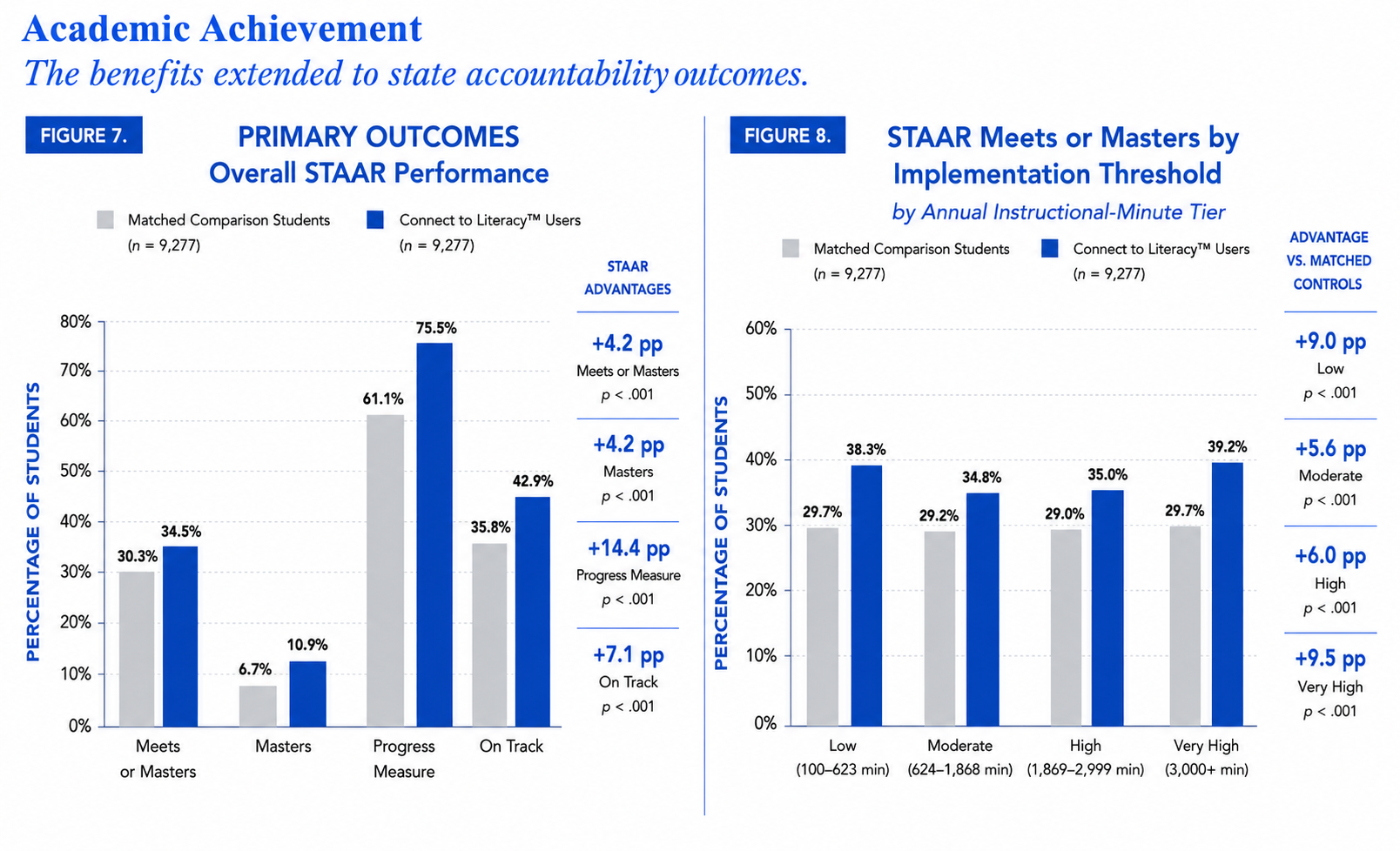
The third study examined student performance on the STAAR Reading assessment. Compared with matched peers, Connect to Literacy students demonstrated statistically significant advantages across each reported outcome.
Among participating students, 34.5% achieved Meets or Masters compared with 30.3% of matched comparison students, a difference of 4.2 percentage points (p < .001). Masters performance was 10.9% among Connect to Literacy students compared with 6.7% among matched peers, also a difference of 4.2 percentage points (p < .001). In addition, 75.5% of participating students demonstrated the STAAR Progress Measure compared with 61.1% of matched comparison students, a difference of 14.4 percentage points (p < .001). On Track performance was 42.9% among participating students and 35.8% among matched peers, a difference of 7.1 percentage points (p < .001).
Connect to Literacy students also demonstrated stronger performance on continuous outcomes. Their average STAAR Scale Score was 32 points higher, average Scale-Score Growth was 14.8 points greater, and average Lexile performance was 50.8 points higher than that of matched comparison students. Each difference was statistically significant at p < .001.
Stronger implementation levels were associated with larger differences in Meets or Masters performance. Students in the highest implementation group demonstrated a 9.5-percentage-point advantage relative to matched comparison students. This graded pattern is noteworthy, although it should be interpreted as an association between implementation level and outcomes rather than conclusive evidence that increased exposure independently caused the higher performance.
The STAAR findings extend the pattern beyond language-proficiency and growth measures to the state’s high-stakes assessment of grade-level performance.
The three studies address different dimensions of multilingual learner development: TELPAS reflects language development, MAP Reading reflects literacy growth, and STAAR reflects grade-level academic achievement. The consistency across all three suggests that an integrated instructional system may support several dimensions of learning at once rather than a single outcome.
Because the assessments measure different constructs, consistency across them is important. It reduces the likelihood that the overall pattern simply reflects one assessment or one type of outcome.
At the same time, the studies should not be treated as direct tests of every pathway represented in the Integrated Multilingual Literacy Framework. The evaluations examined the performance of students participating in an integrated instructional system; they did not independently isolate the effects of literacy instruction, language development, assessment, professional learning, coaching, leadership, or other implementation support.
The findings therefore provide empirical support consistent with the framework rather than definitive proof of its causal mechanisms. They suggest that when evidence-based literacy instruction, language development, assessment, and implementation supports are organized as a coherent system, multilingual learners may experience stronger outcomes across multiple dimensions of learning.
Across measures of English language proficiency, reading growth, and academic achievement, multilingual learners participating in the integrated system consistently showed stronger outcomes than carefully matched comparison students. The most important feature of the results is their consistency across three distinct measures.
What stands out is not one effect size. It is the consistency of the pattern. Across three studies, three different assessments, and three distinct outcomes, multilingual learners participating in the integrated instructional system showed stronger performance than carefully matched comparison students.
The findings extend beyond improvement on a single assessment. They point to advantages across several dimensions of learning that are often examined separately, consistent with the idea that evidence-based practices are stronger when they operate as parts of a coherent system.
The field has already made substantial progress identifying effective practices. The Science of Reading has clarified skilled reading, multilingual learner research has deepened our understanding of the relationship between language and literacy, and implementation science has identified conditions that support consistent practice. The next challenge is how to organize that evidence into a coherent system.
The Integrated Multilingual Literacy Framework is one response to that challenge. It does not propose a new theory of reading or language development. It brings established evidence together in a model that connects literacy instruction, language development, assessment, professional learning, coaching, leadership, and continuous improvement. The premise is simple: if skilled reading depends on multiple cognitive and linguistic processes working together, the instructional systems around students should be designed with the same kind of coordination.
The empirical findings are consistent with this proposition. Across three complementary studies conducted under authentic district implementation conditions, positive differences were observed in English language proficiency, reading growth, and academic achievement. While additional research across diverse educational settings is warranted, the convergence of these findings provides encouraging evidence that intentionally integrating literacy instruction, language development, and implementation supports may contribute to stronger outcomes for multilingual learners.
One clear implication is that literacy and language development should not be treated as separate priorities. Multilingual learners develop language through reading, writing, discussion, and content learning while using growing language proficiency to engage in increasingly sophisticated literacy. The relationship is reciprocal, not sequential.
The findings presented here are consistent with this perspective. Students participating in the integrated multilingual literacy system demonstrated stronger English language proficiency, exceeded expected reading growth, and achieved higher levels of academic performance than carefully matched comparison students. Although these studies cannot establish the causal relationships among these outcomes, the consistency of the findings across three complementary assessments suggests that literacy and language development may reinforce one another when intentionally integrated within classroom instruction.
This interpretation also follows the evolution of literacy theory, from the Simple View’s word recognition and language comprehension to the Reading Rope’s interconnected strands, to the Active View’s emphasis on coordination during reading. The Integrated Multilingual Literacy Framework extends that progression to the instructional system. In this sense, coherence is not only an organizational characteristic; it is an instructional principle.
Implementation is a critical part of that coherence. Across all three studies, stronger implementation was associated with stronger student outcomes. The studies measured implementation in different ways, so the pattern should be interpreted carefully. Even so, it aligns with a long-standing finding from implementation science: evidence-based practices have more impact when educators can use them consistently and when leadership, coaching, professional learning, assessment, and continuous improvement support the work.
For multilingual learners, this coherence may be especially important. Teachers are often developing foundational literacy, oral language, vocabulary, academic discourse, writing, and knowledge within the same instructional experience. Implementation therefore helps not only sustain strong practices, but coordinate them.
These findings also speak to the growing debate about educational technology in schools. Concerns about screen time, passive digital learning, and student-facing artificial intelligence have led some to argue that schools should pull back from technology altogether. The evidence here points to a more useful question: not whether technology belongs in literacy instruction, but whether it strengthens the instructional relationships and practices that matter most.
The Integrated Multilingual Literacy Framework does not position technology as a substitute for teachers or high-quality instruction. Technology is one part of a larger system in which curriculum, assessment, professional learning, language development, and educator expertise remain central. Digital tools should help teachers provide explicit instruction, monitor progress, differentiate learning, and give timely feedback. They should not replace the human interaction through which language, literacy, and academic identity develop.
This matters especially for multilingual learners. Effective technology should create opportunities for richer language interactions, more responsive formative assessment, and greater access to rigorous content while preserving the essential role of teacher-guided discussion, collaborative learning, and meaningful communication. When implemented within coherent instructional systems, educational technology has the potential to amplify—not substitute for—the evidence-based practices that support multilingual literacy development.
The findings also have important implications for district leaders responsible for designing, implementing, and continuously improving multilingual literacy systems. If the central proposition of this article is correct—that stronger outcomes emerge when evidence-based literacy instruction, language development, and implementation supports function as a coherent system—then the work of district leadership extends beyond selecting high-quality instructional materials. It includes intentionally designing the organizational conditions that enable those components to reinforce one another across classrooms.
First, literacy and language development should be designed as complementary dimensions of the same instructional experience rather than separate instructional initiatives. Multilingual learners do not develop reading, language, vocabulary, writing, and knowledge sequentially or independently. These processes develop simultaneously through meaningful engagement with complex texts, discussion, writing, and content learning. District curriculum, instructional planning, assessment, and professional learning should therefore reflect this reciprocal relationship rather than treating literacy and English language development as parallel systems.
Second, implementation should be viewed as a strategic investment rather than an operational task. High-quality instructional materials provide an essential foundation, but they are unlikely to produce consistent results without coherent implementation. Professional learning, instructional coaching, leadership, assessment, and continuous improvement should be intentionally aligned to support educators in translating research into consistent classroom practice. The findings presented here suggest that implementation quality may be as consequential as curriculum quality in determining student outcomes.
Third, districts should evaluate success through multiple complementary indicators rather than relying on a single assessment. Language proficiency, reading growth, and academic achievement each illuminate different dimensions of multilingual learner development. Examining these measures together provides a more comprehensive understanding of instructional effectiveness, enables earlier identification of strengths and challenges, and supports continuous improvement grounded in multiple sources of evidence rather than a single accountability metric.
For district leaders, this may require a different starting question. Instead of asking, “Which evidence-based practice should we adopt?” ask, “How do we organize evidence-based practices so they work together as a coherent instructional system?” That changes the work from adding initiatives to building a system that can sustain better instruction over time.
Over the past two decades, the Science of Reading, multilingual learner research, and implementation science have changed what we know about reading, language development, and effective implementation. The next challenge is not simply figuring out what works. It is figuring out how the practices we know work can function together as a coherent system.
The Integrated Multilingual Literacy Framework proposed in this article addresses that challenge by synthesizing these complementary bodies of research into a systems perspective. Evidence from three complementary efficacy studies provides empirical findings consistent with this framework. Across measures of English language proficiency, reading growth, and academic achievement, multilingual learners participating in an integrated instructional system consistently demonstrated stronger outcomes than carefully matched comparison students. Although additional research across diverse educational contexts is warranted, the convergence of findings across multiple independent measures strengthens confidence that coherent instructional systems may provide meaningful benefits for multilingual learners.
As schools reconsider the role of educational technology and artificial intelligence, the findings of this manuscript suggest that the question should not be whether technology belongs in literacy instruction, but whether it meaningfully strengthens the relationships among teachers, students, language, and learning within coherent instructional systems.
The broader lesson goes beyond any one study. Future progress in multilingual literacy may depend less on discovering another instructional practice and more on improving how the evidence we already have is organized and put into practice. We know a great deal about explicit literacy instruction, language development, and effective implementation. The opportunity now is to connect those strengths so they reinforce one another in the classroom.
If skilled reading develops through the coordination of multiple cognitive and linguistic processes, the systems supporting students should be coordinated too. The future of multilingual literacy is not simply about better programs or better practices. It is about building better systems that bring literacy, language, implementation, and educator expertise together in ways students can actually experience.
August, D., & Shanahan, T. (Eds.). (2006). Developing literacy in second-language learners: Report of the National Literacy Panel on Language-Minority Children and Youth. Lawrence Erlbaum Associates.
Bryk, A. S., Gomez, L. M., Grunow, A., & LeMahieu, P. G. (2015). Learning to improve: How America's schools can get better at getting better. Harvard Education Press.
Burns, M. K., Duke, N. K., & Cartwright, K. B. (2023). Evaluating components of the Active View of Reading as intervention targets: Implications for social justice. School Psychology, 38(1), 30–41.
Castles, A., Rastle, K., & Nation, K. (2018). Ending the reading wars: Reading acquisition from novice to expert. Psychological Science in the Public Interest, 19(1), 5–51.
Cervetti, G. N., Pearson, P. D., Palincsar, A. S., & Afflerbach, P. (2007). Reading and writing in the service of inquiry-based science. In R. A. Duschl & R. E. Grandy (Eds.), Teaching scientific inquiry: Recommendations for research and implementation (pp. 221–244). Sense Publishers.
Cummins, J. (1979). Cognitive/academic language proficiency, linguistic interdependence, the optimum age question and some other matters. Working Papers on Bilingualism, 19, 121–129.
Cummins, J. (2000). Language, power and pedagogy: Bilingual children in the crossfire. Multilingual Matters.
Duke, N. K., & Cartwright, K. B. (2021). The science of reading progresses: Communicating advances beyond the Simple View of Reading. Reading Research Quarterly, 56(S1), S25–S44.
Ehri, L. C. (2020). The science of learning to read words: A case for systematic phonics instruction. Reading Research Quarterly, 55(S1), S45–S60.
Fixsen, D. L., Naoom, S. F., Blase, K. A., Friedman, R. M., & Wallace, F. (2005). Implementation research: A synthesis of the literature. University of South Florida, National Implementation Research Network.
Fullan, M. (2020). Leading in a culture of change (2nd ed.). Jossey-Bass.
García, O., & Kleifgen, J. A. (2018). Educating emergent bilinguals: Policies, programs, and practices for English learners (2nd ed.). Teachers College Press.
Goldenberg, C. (2020). Reading wars, reading science, and English learners. Reading Research Quarterly, 55(S1), S131–S144. https://doi.org/10.1002/rrq.340
Goodwin, A. P., & Jiménez, R. T. (2020). The Science of Reading: Supports, Critiques, and Questions. Reading Research Quarterly, 55(S1), S7–S16. https://doi.org/10.1002/rrq.360
Gough, P. B., & Tunmer, W. E. (1986). Decoding, reading, and reading disability. Remedial and Special Education, 7(1), 6–10.
Hoover, W. A., & Gough, P. B. (1990). The Simple View of Reading. Reading and Writing: An Interdisciplinary Journal, 2(2), 127–160.
National Academies of Sciences, Engineering, and Medicine. (2017). Promoting the educational success of children and youth learning English: Promising futures. National Academies Press.
National Reading Panel. (2000). Teaching children to read: An evidence-based assessment of the scientific research literature on reading and its implications for reading instruction. National Institute of Child Health and Human Development.
Scarborough, H. S. (2001). Connecting early language and literacy to later reading (dis)abilities: Evidence, theory, and practice. In S. B. Neuman & D. K. Dickinson (Eds.), Handbook of early literacy research (Vol. 1, pp. 97–110). Guilford Press.
Shanahan, T. (2023). A review of the evidence on Tier 1 instruction for readers with dyslexia. Reading Research Quarterly, 58(2), 268–284. https://doi.org/10.1002/rrq.438
Snow, C. E. (2002). Reading for understanding: Toward an R&D program in reading comprehension. RAND.
U.S. Department of Education, Institute of Education Sciences, National Center for Education Evaluation and Regional Assistance. (2022). What Works Clearinghouse: Procedures and standards handbook (Version 5.0). https://ies.ed.gov/ncee/wwc/handbooks
Warschauer, M. (2026, July 27). Walking away from education technology isn't the answer to the latest backlash. The Washington Post. https://www.washingtonpost.com/ripple/2026/07/27/opinion-walking-away-from-education-technology-isnt-the-answer-to-the-latest-backlash/