Three Reads With a Purpose: Helping Students Reason Through Math Problems
Give every reread a purpose. A classroom guide to the Three Reads routine, with a grade 6 rate example, newcomer supports, and tools for responding to student thinking.

Give every reread a purpose. A classroom guide to the Three Reads routine, with a grade 6 rate example, newcomer supports, and tools for responding to student thinking.
A correct answer gives us something to examine. Students’ representations and explanations help us understand how they reached it and how they can grow. Purposeful rereading creates opportunities to develop mathematical understanding and the language students need to express, examine, and refine their ideas.
Step into a sixth-grade classroom where students are exploring how long a walk might take. As they sketch routes, discuss distances, and connect elapsed time to a constant pace, they use ratio and proportional reasoning to make and justify predictions. A teacher displays a short scenario: Elizabeth walks 2 kilometers in 26 minutes. How long does it take her to walk 5 kilometers? One student answers “65.” Another draws a walking path and labels it in Spanish. A third says, “More distance, more time.” What does each response tell us? Before deciding who needs help and what kind, we need to understand how each student is interpreting the situation and connecting the quantities. The Three Reads Language Routine gives teachers a structure for investigating that thinking while helping students develop it.
Language helps students interpret mathematical situations, explain relationships, and examine their reasoning. The Stanford Understanding Language/SCALE framework connects mathematical learning with language development and emphasizes reflection on thinking and language use (Zwiers et al., 2017). The infographic Bridging Language and Content Learning by Howard et al. (n.d.) illustrates the framework’s four design principles and offers classroom applications.
Teachers can make reflection concrete by asking students how their understanding changed and which wording helped them interpret a relationship. In the walking problem, a student might say, “At first, I thought I should add 3 minutes. Then I noticed each kilometer takes the same amount of time.” Another might explain, “At this pace tells me that equal distances take equal amounts of time.” The first offers evidence of reflection on thinking, or metacognition. The second offers evidence of attention to how language conveys meaning, or metalinguistic awareness.
Completing three readings does not, by itself, demonstrate either skill. Listen to students’ explanations, ask them to clarify, and examine their representations. Drawings, gestures, and explanations across languages can help students communicate ideas as they develop precise mathematical language.
A model helps students explain what a calculation or algorithm represents. In the walking problem, students might divide a 2-kilometer route into two equal distances and pair each kilometer with 13 minutes. Connecting that representation to 26 ÷ 2 = 13 gives the operation meaning. Students can then explain why multiplying 13 by 5 gives the time for 5 kilometers.
Research on concreteness fading, which gradually connects concrete materials with more abstract representations, offers a useful perspective. Fyfe et al. (2015) found stronger transfer on mathematical equivalence tasks when concrete materials faded into abstract representations. Although the study did not examine Three Reads, it offers a useful instructional connection: help students explain how models, language, and equations represent the same relationship. In “Concrete + Abstract = Math Learning,” Andrew Watson (2019) discusses this study and its instructional implications.
The three readings should not become a required sequence of concrete materials, pictures, and symbols. Students may move among representations, begin with an equation, or return to a model when an operation loses its meaning. Ask, “Where do you see this relationship in your model, and how does your equation show it?” Use the explanation to decide which connections need attention. Make the purpose of each reading and representation explicit so students can reflect on what deepens their understanding and independently decide when to reread, change approaches, or return to a model. NCTM (2023) emphasizes connecting concepts and procedures while developing students’ ability to select and apply strategies accurately, efficiently, and flexibly.
Plan these opportunities to invite student reasoning and language from the beginning of the lesson so students can interpret relationships and develop the reasoning before following a procedure. The mathematical goal in this example is to identify and use a constant rate to find an unknown time. The language goal is to explain how the quantities relate and why a chosen method works.
The following classroom adaptation draws on Three Reads, MLR6, in Zwiers et al. (2017). The question is withheld until Read 3. Clarify the context and essential language as needed, while giving students an opportunity to propose an approach before demonstrating a solution method. The routine organizes attention, not a lockstep schedule for students’ thinking.
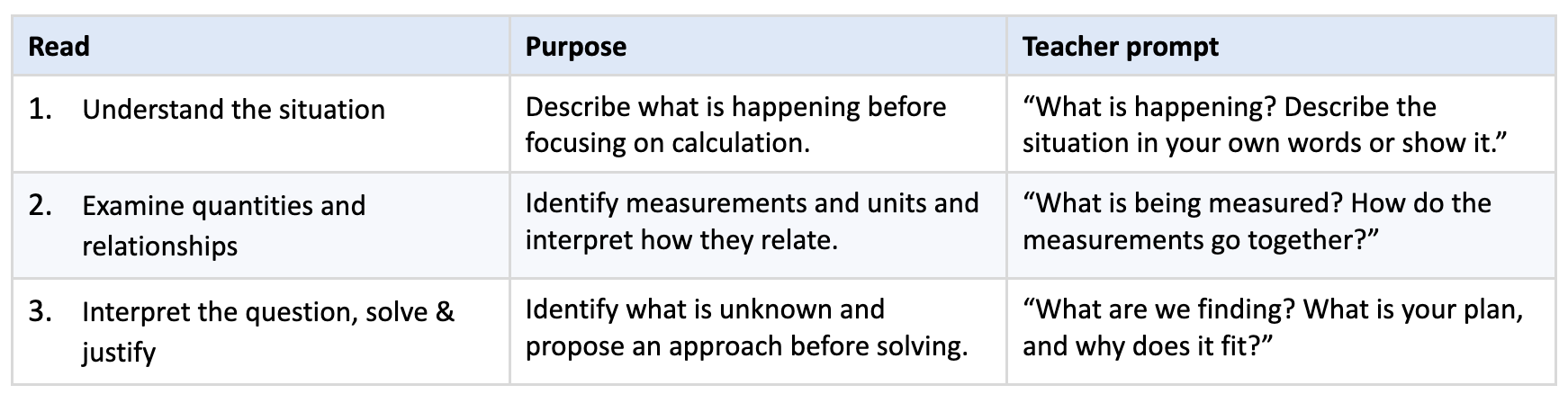
Keep the situation visible and read it aloud. Invite students to draw, gesture, label, and discuss in their home languages as well as English. Provide time for partner rehearsal and ask partners to help clarify ideas. Use students’ explanations to introduce relevant English terms; do not require a polished sentence before engaging with their reasoning.
Teachers share responsibility for understanding what students mean. When a home-language explanation is unfamiliar, ask the student to connect it to a representation and use available bilingual resources to clarify meaning. Newcomers’ mathematical experiences vary; investigate what each learner knows without assuming either mastery or difficulty.

An illustrative grade 6 rate-reasoning scenario
The teacher displays: “Elizabeth walks at a constant pace. She walks 2 kilometers in 26 minutes.” The intended question remains hidden during the first two readings, inviting students to describe the situation, ask their own questions, and use their languages and representations to explore relationships before focusing on a particular answer or procedure.
The teacher reads aloud and asks, “What is happening? How could you show it?” One student draws a walking path and labels it distancia and tiempo. The teacher asks, “Show me what each label represents.” The student points to the path and a clock, and the teacher adds distance and elapsed time beside the labels. Distancia and distance are cognates; tiempo and time are a translation pair.
The teacher follows up: “How could your drawing show that the distance and time are both changing?” The labels help identify the quantities, but they do not yet establish how the student understands their relationship.
The teacher rereads the situation and asks, “What is being measured? What does constant pace tell us?” Another student says, “More distance, more time.”
The teacher responds, “Show where the 2 kilometers and 26 minutes belong. What would stay the same if Elizabeth kept walking at this pace?” The student draws a second equal route section and labels it 26 minutes. The teacher asks, “Explain why those sections have the same time.” The student points to the equal distances and explains that the pace does not change.
If a “constant pace” is unfamiliar language, the teacher clarifies it briefly and clearly: equal distances take equal amounts of time in this situation. Concrete models and brief demonstrations can help students connect the situation to experience. For example, the teacher can mark a short distance with a measuring tape and use a timer as someone walks that distance, making both distance and elapsed time visible before connecting them to a diagram or representation. Then, the teacher asks the student to show that meaning in the model. The clarification supports interpreting the scenario without prescribing a solution method.
The teacher reveals: “At this pace, how long would it take Elizabeth to walk 5 kilometers?” Students first consider a plan and discuss it with a partner. The teacher asks, “What do you need to find, and how could the information help?” Students then solve.
One student answers “65.” The teacher asks, “How does your representation show why 65 minutes makes sense?” The student partitions the original 2-kilometer interval into two equal parts, assigns 13 minutes to each kilometer, and extends the representation to 5 kilometers. The teacher asks, “Where does your model show 26 ÷ 2? Where does it show 13 × 5?”
Another student uses 26 + 26 + 13 = 65 minutes for 2 + 2 + 1 kilometers. The class compares how both methods preserve the same rate. The teacher invites the student who initially said “More distance, more time” to explain the relationship again after partner rehearsal, then checks it with a follow-up question rather than relying on a repeated sentence.
When solving proportions is part of the learning goal, the teacher can also connect these strategies to 26/2 = t/5. Multiplying both sides by 10 gives 5(26) = 2t, showing why cross multiplication preserves equality. This moves students toward a more abstract method while preserving the relationship represented.
A correct answer, Spanish labels, and a brief English sentence each offer partial evidence. A response becomes more informative when the student explains a connection, answers a new question, or revises a representation. Treating revision as an expected and valuable part of mathematics encourages students to revisit ideas, refine explanations, and use feedback to deepen their understanding. The teacher uses those responses to decide whether the next step concerns the mathematics, the language used to express it, or both.
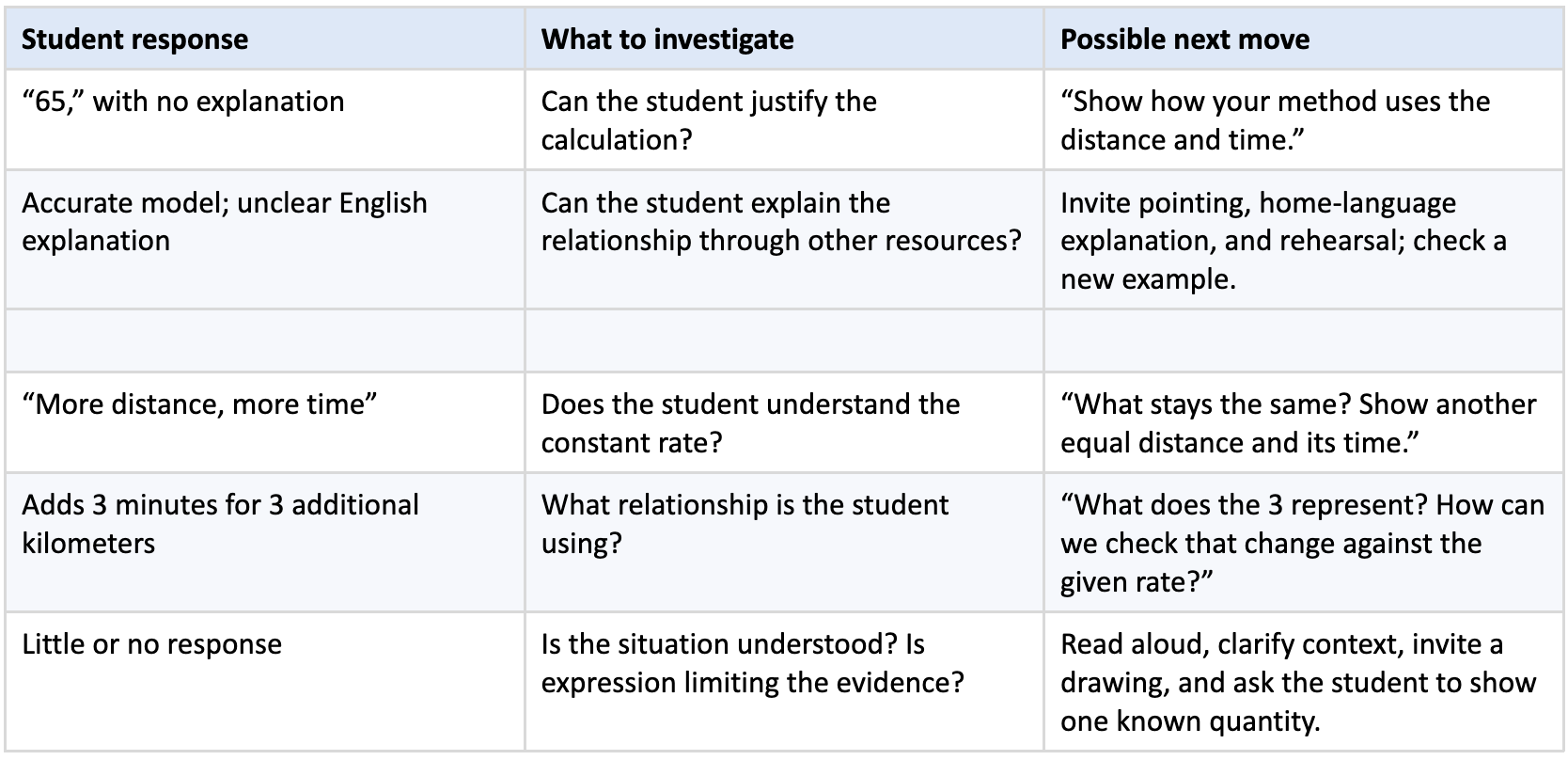
Illustrative student work and teacher prompts for the Elizabeth walking problem. These examples show possible responses.
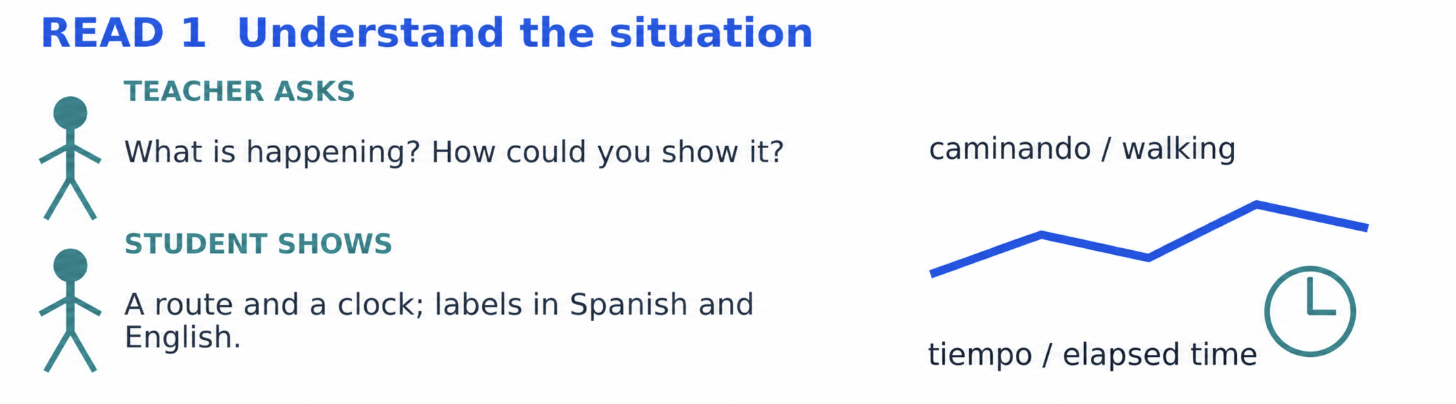
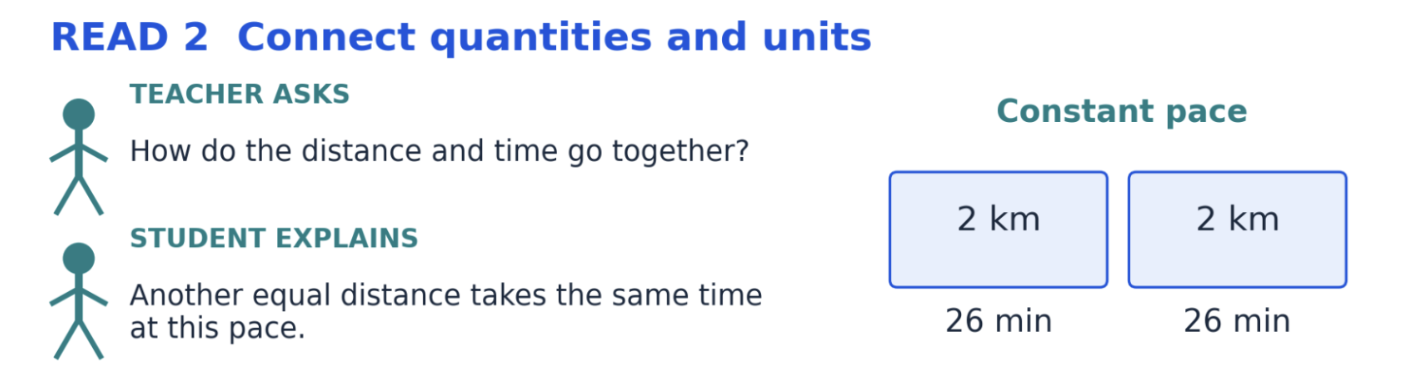
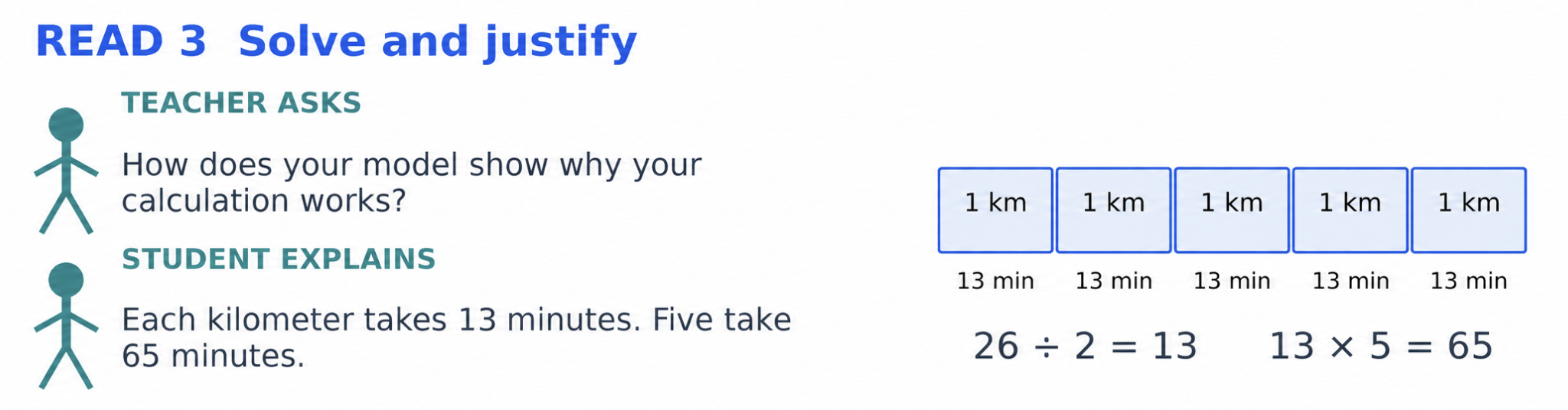
Use these comparisons to support access while preserving students’ responsibility for reasoning.
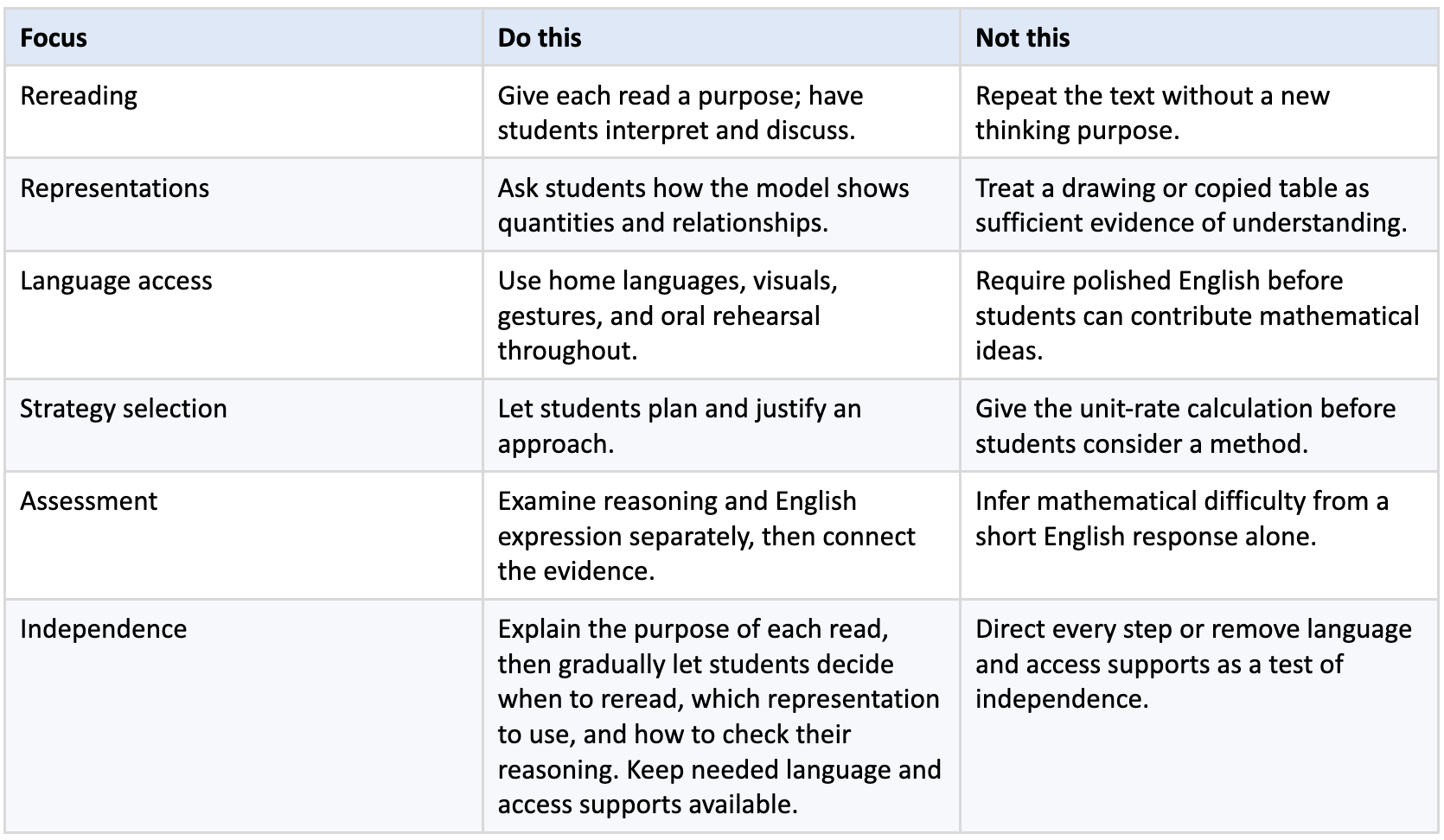
Use responses to investigate students’ understanding and select an initial support; check what their next response reveals. Connect feedback to the goal, current progress, and next steps (Hattie & Timperley, 2007).
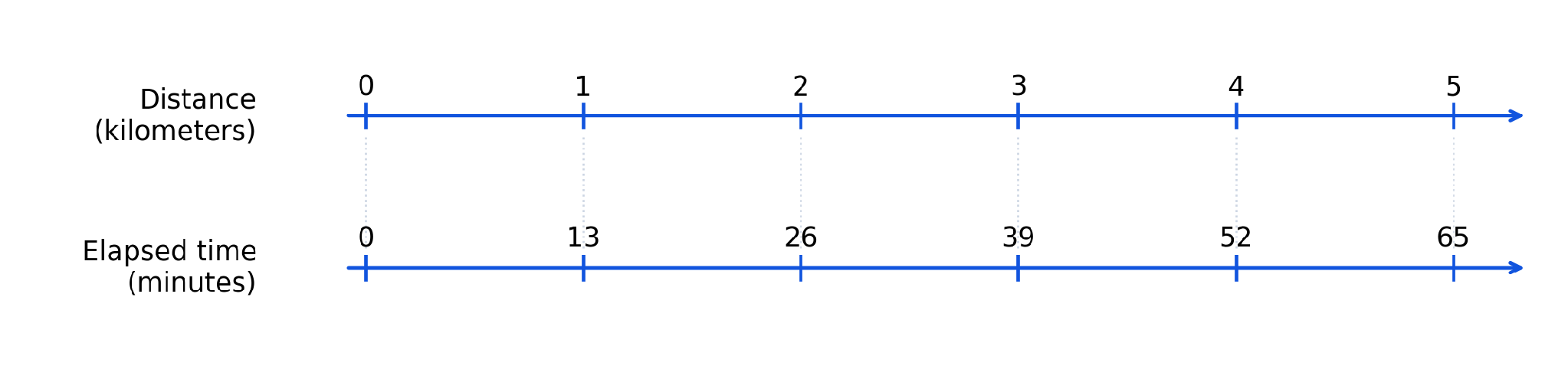
The aligned marks on this double number line show equivalent distance-and-time pairs. Ask students what the alignment means and how the same relationship appears in an equation. Offer this completed exemplar after students have created their own representations.
Unit-rate method: 26 ÷ 2 = 13 minutes per kilometer; 13 × 5 = 65 minutes.
Alternative method: 26 + 26 + 13 = 65 minutes for 2 + 2 + 1 kilometers.
Elizabeth walks 2 kilometers in 26 minutes at a constant pace. I divided 26 by 2 to find the time for 1 kilometer: 13 minutes. Then I multiplied 13 by 5 to find the time for 5 kilometers. She would take 65 minutes. My model shows five equal 1-kilometer intervals, with 13 minutes for each interval.
Elizabeth camina 2 kilómetros en 26 minutos a un ritmo constante. Dividí 26 entre 2 para encontrar el tiempo que tarda en recorrer 1 kilómetro: 13 minutos. Después multipliqué 13 por 5 para encontrar el tiempo que tarda en recorrer 5 kilómetros. Tardaría 65 minutos. Mi modelo muestra cinco intervalos iguales de 1 kilómetro, con 13 minutos para cada intervalo.
Invite students to notice how each explanation names quantities and units, sequences actions, and justifies operations. Ask them to identify a phrase that makes the reasoning clearer and revise their own explanation if useful. Welcome other valid methods and wording. A mentor text is an example to examine, not a script to reproduce. Language develops over time; use language-development frameworks and assessment tools to recognize progress and plan appropriate feedback across lessons.
Another possible language objective could be: Explain how distance and elapsed time change together at a constant pace, using a labeled representation and an oral or written explanation. Use the language-development standards for your setting to refine the expected language and supports.
After solving, ask, “What changed or confirmed your understanding?” and “Which words helped you interpret the relationship?” If a student identifies at this pace, follow with, “What does that phrase mean here? How does your model show it?” Notice whether the student explains the relationship rather than simply names a phrase.
Use a new situation: “A machine fills 3 identical bottles in 24 seconds at a constant rate. How long will it take to fill 7 bottles?” Initially ask students to choose how to make sense of the problem and explain their plan. Keep read-alouds, home-language resources, and other needed access options available.
Look for whether students identify the paired quantities, interpret the rate, choose a useful representation or calculation, and justify the answer. One method is 24 ÷ 3 = 8 seconds per bottle, then 8 × 7 = 56 seconds. Another is 24 + 24 + 8 = 56 seconds for 3 + 3 + 1 bottles. Do not show these methods before students attempt the task.
Ask, “What did you reread, and why?” Record the prompting needed. Success on this task is evidence of application in a new context, not proof of broad transfer. If reasoning is unclear, investigate again. If the reasoning is sound but the English explanation is limited, support expression while continuing to check the mathematics.
Before revealing the intended question on a math task, invite students to generate mathematical questions about the situation, compare them with a partner, and clarify what each asks. This draws on MLR5, Co-Craft Questions and Problems (Zwiers et al., 2017). Possible questions for the scenario with Elizabeth walking can include “How far could Elizabeth walk in 52 minutes?” and “How long would 1 kilometer take?”
If a student asks “How fast?”, clarify whether the question seeks kilometers per minute or minutes per kilometer. Discuss how the wording identifies the unknown. Then return to the planned question or choose one that serves the lesson’s mathematical goal.
Before asking students to read again, decide what this reading should help them understand, and what their response will help you understand about their thinking.
Fyfe, E. R., McNeil, N. M., & Borjas, S. (2015). Benefits of “concreteness fading” for children’s mathematics understanding. Learning and Instruction, 35, 104–120.
Hattie, J., & Timperley, H. (2007). The power of feedback. Review of Educational Research, 77(1), 81–112.
Howard, S., Loescher, J., & Lopez Hurtado, I. (n.d.). Bridging language and content learning: Are math language routines and design principles worth the trouble? [Infographic]. CREATEd, Center for Research Use in Education, University of Delaware.
National Council of Teachers of Mathematics. (2023, January). Procedural fluency: Reasoning and decision-making, not rote application of procedures [Position statement].
Watson, A. (2019, December 7). Concrete + abstract = math learning. Learning & the Brain.
Zwiers, J., Dieckmann, J., Rutherford-Quach, S., Daro, V., Skarin, R., Weiss, S., & Malamut, J. (2017). Principles for the design of mathematics curricula: Promoting language and content development (Version 2.0). Stanford University, Understanding Language/SCALE.