Teaching the Code. Building the Reader.
Five Shifts to Keep the Science of Reading from Becoming the Science of Phonics
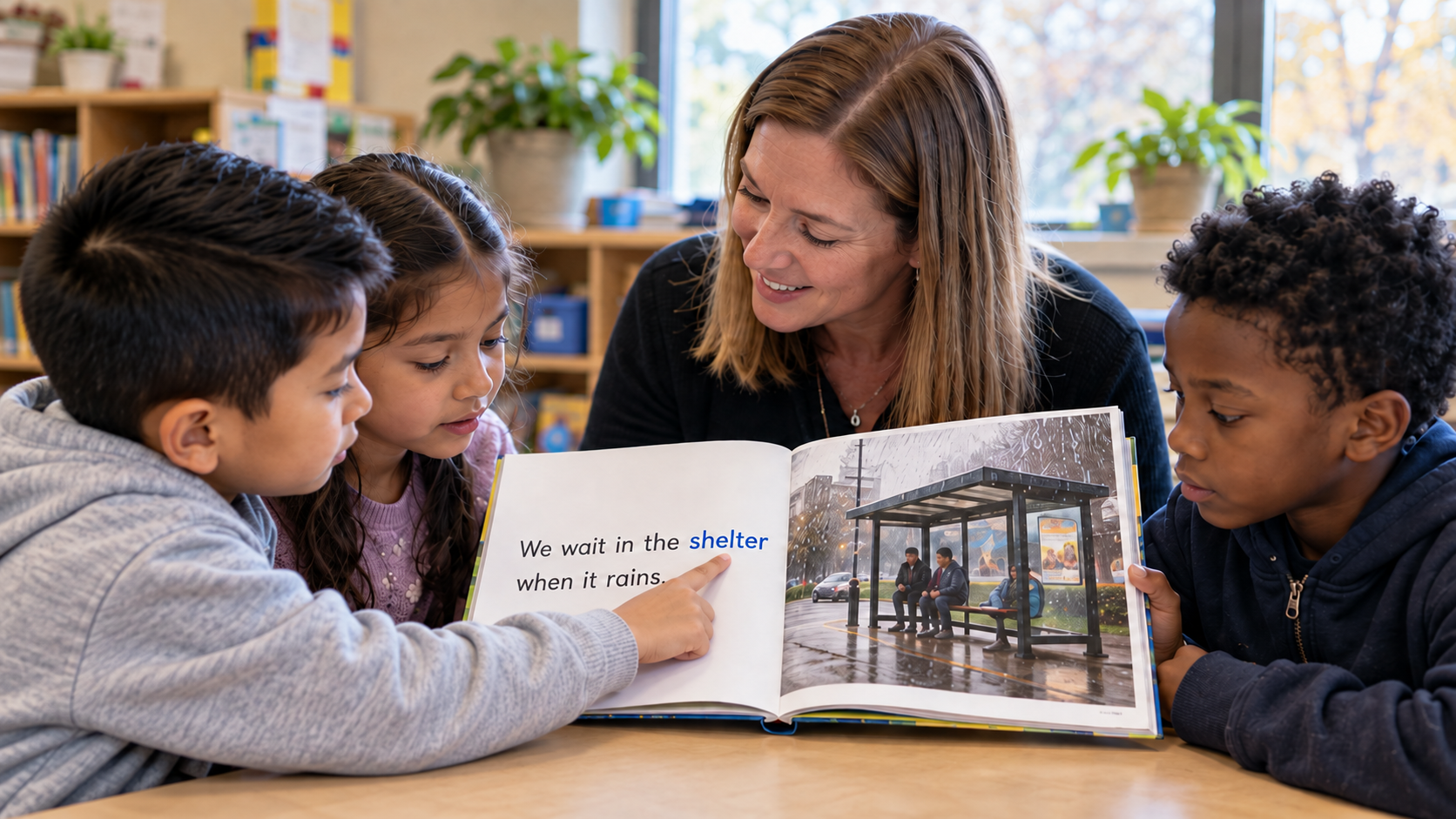
Five Shifts to Keep the Science of Reading from Becoming the Science of Phonics
Multilingual learners need explicit, systematic foundational-skills instruction. But teaching children to crack the code is only part of teaching them to read. The code should never become the curriculum. Foundational skills must build toward language, knowledge, comprehension, and increasingly independent reading and writing.
The science of reading has helped bring needed attention to explicit, systematic foundational-skills instruction. But there is an emerging implementation challenge: in strengthening phonics, we can inadvertently narrow what it means to teach reading.
Recent classroom research makes that risk visible. In a study of 112 K–2 classrooms across four districts, teachers were implementing foundational-skills curricula with fidelity and providing explicit, systematic instruction. Yet students had opportunities to apply those skills beyond single words in only about one in five lessons. In more than half, word meaning was addressed once or not at all.
That matters for every beginning reader. For multilingual learners, it matters even more. They may be learning the English sound system, vocabulary, and orthography simultaneously, while also drawing on an existing language system and knowledge developed in another language.
So the question is not whether multilingual learners need explicit phonics instruction. They do. The question is how we teach the English code without separating it from the language, meaning, and knowledge that make reading worth doing.
Phonemic awareness, phonics, decoding, spelling, and fluency are essential. But they belong within a comprehensive approach to literacy, where oral language, vocabulary, knowledge, comprehension, writing, discussion, and meaningful reading develop alongside them.
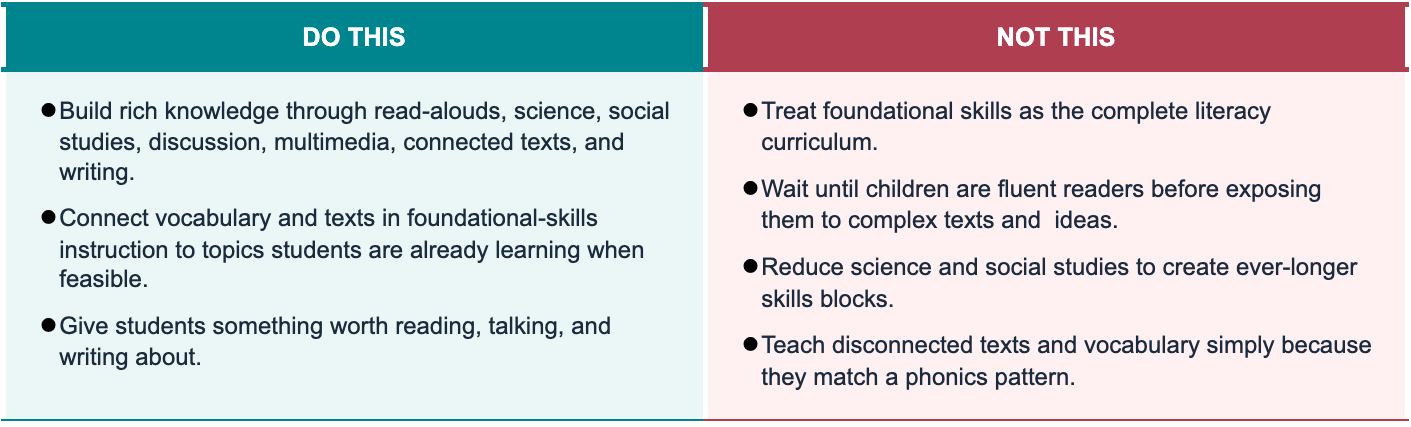
That means knowledge-building cannot wait until children become proficient decoders. Young learners can encounter sophisticated ideas and language through read-alouds, conversation, science, social studies, multimedia, and texts they increasingly read themselves. Foundational skills give students greater access to that world; they should not become the price of admission.
For multilingual learners, this integration is especially important. They are not simply learning to decode English. They are developing English as they read, talk, listen, write, build knowledge, and connect new learning to what they already know.
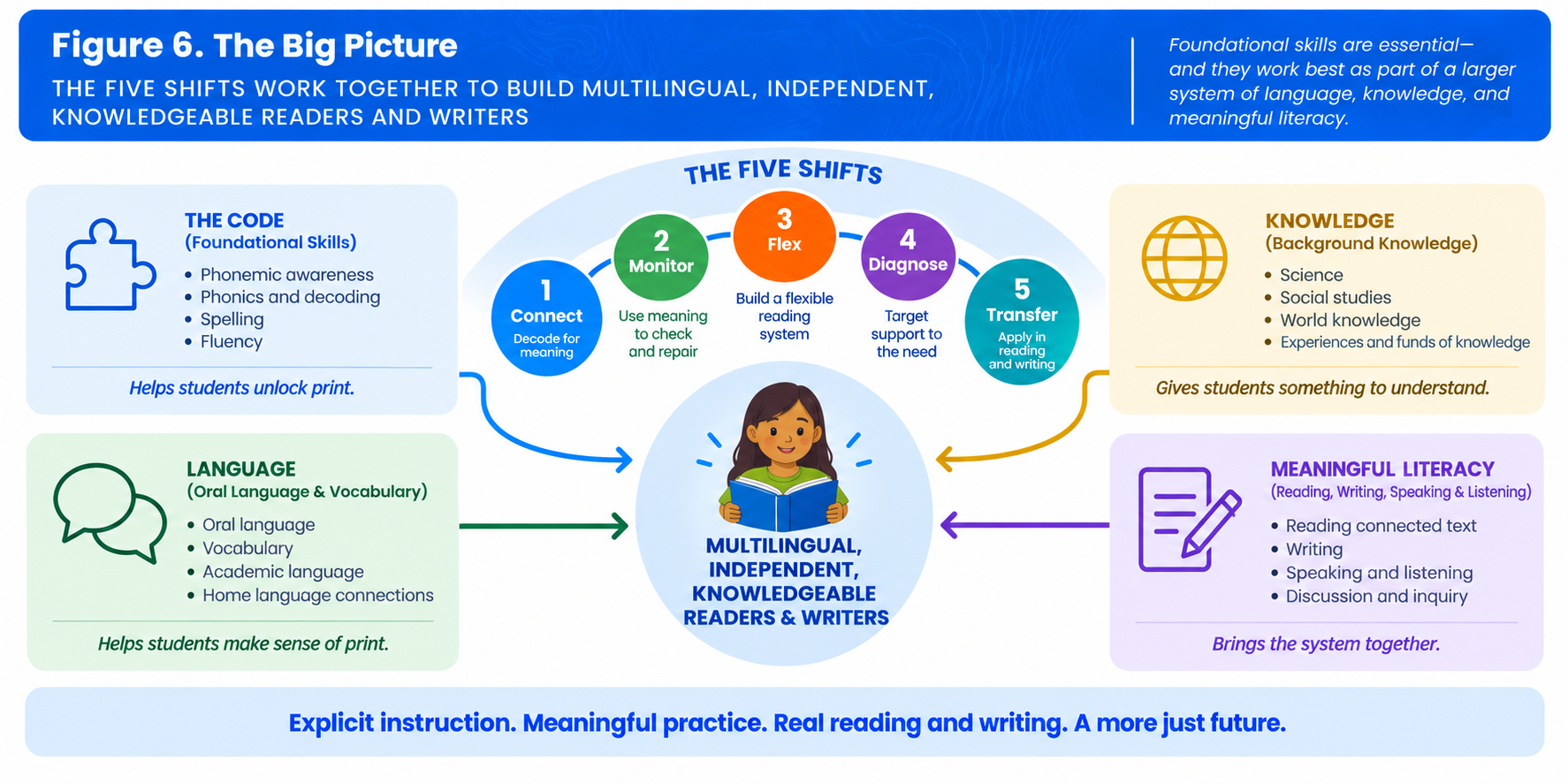
Foundational skills help children unlock print.
Language helps them make sense of it.
Knowledge gives them something to understand.
Reading, writing, speaking, and listening bring the system together.
We have become much clearer about what teachers should not do when a beginning reader encounters an unfamiliar word. Students should not be taught to guess from a picture, rely on the first letter, or choose a word simply because it makes sense.
But eliminating those practices leaves an equally important question:
What should a teacher do instead?
What happens when a multilingual learner looks carefully at the print and decodes the word correctly—but doesn't know what the word means in English? When is meaning useful? When should the teacher return the student to the print? When is the problem actually pronunciation, vocabulary, or language rather than decoding? When does a student need more practice—and when do they need an opportunity to apply what they know in connected reading?
Those are not small instructional decisions. They determine whether foundational-skills instruction remains an isolated exercise or becomes part of learning to read.
The following five shifts show how to keep explicit foundational-skills instruction connected to the larger work of learning to read—accurately, meaningfully, and increasingly independently.
Word recognition and language comprehension are often represented as separate parts of reading. In instruction, they can become separate as well. That creates a false choice.
When a student encounters an unfamiliar written word, attention should go first to the print: the letters, sound-spelling relationships, and orthographic patterns that identify the word. But identifying the word is not the end of reading. Students also need to connect the printed word to a word they know—or are learning—in spoken language and understand what it means.
For multilingual learners, that connection may need to be made explicit. A student can decode a word accurately without knowing the word in English. A brief definition, gesture, visual, example, cognate, or connection to context can attach meaning to the decoded word without replacing attention to print or turning every phonics lesson into an extended vocabulary lesson (Jennerjohn et al., 2026).
The sequence matters: print identifies the word; language connects the word to meaning.
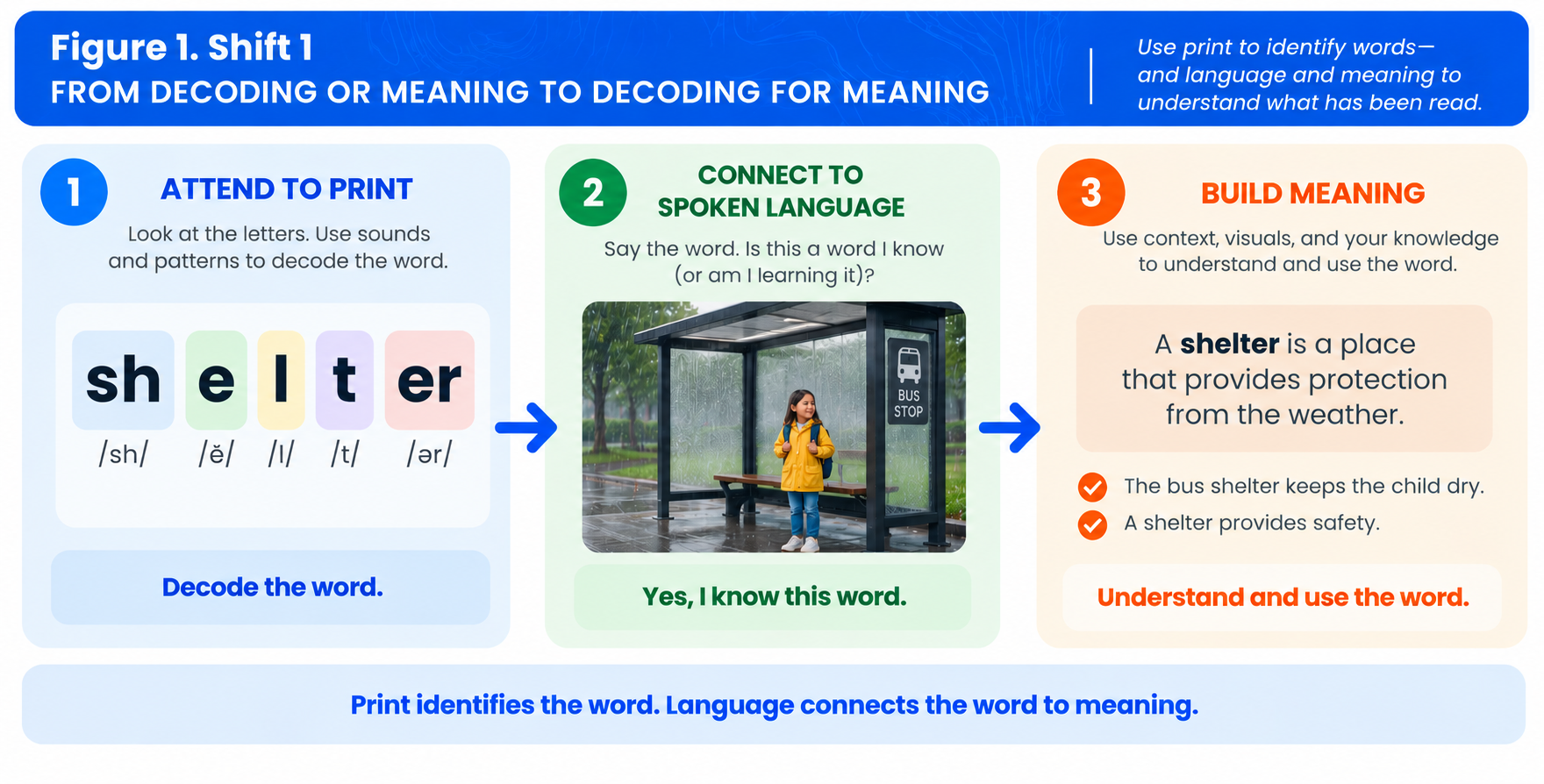
When students ask, “What is that word?”, attention should go to the print. Letters, sound-spelling relationships, and orthographic patterns do the work of word identification.
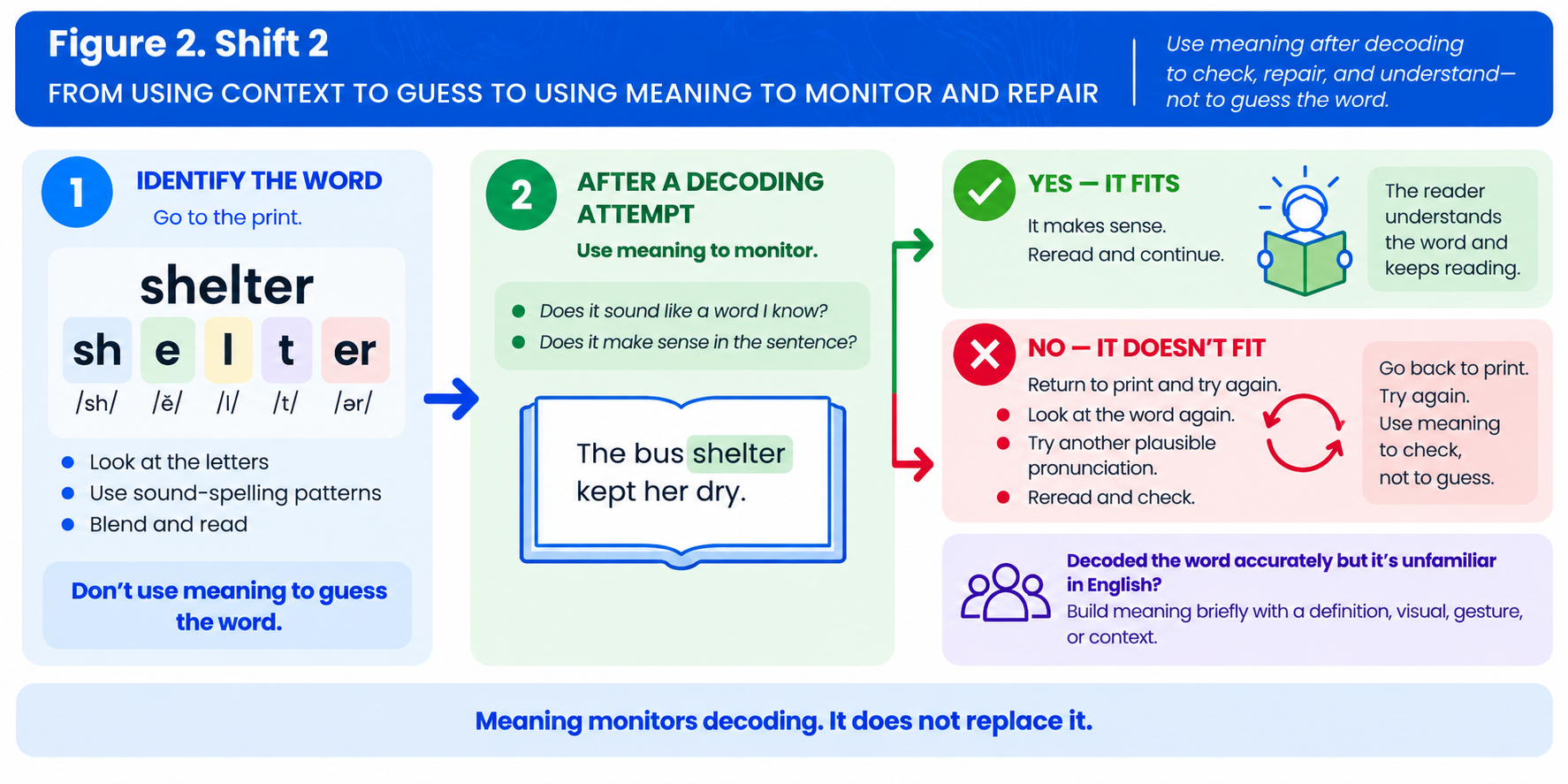
But after a decoding attempt, meaning has an important—and different—job.
Now the student can ask: “Did I read that right?”
If a child reads sweat as sweet, the mismatch between the decoded word and the sentence can signal that something needs another look. The student returns to the print, considers another plausible pronunciation, rereads, and confirms. That is not using context to guess the word. It is using meaning to monitor and repair a decoding attempt (Duke, 2020).
For multilingual learners, one additional question matters: Does the student know the decoded word in spoken English? If the decoding is accurate but the word is unfamiliar, asking “Does that sound right?” may not help. A brief explanation, visual, gesture, or surrounding context can establish meaning and support comprehension. At that point, meaning is building understanding—not replacing decoding (Duke, 2020).
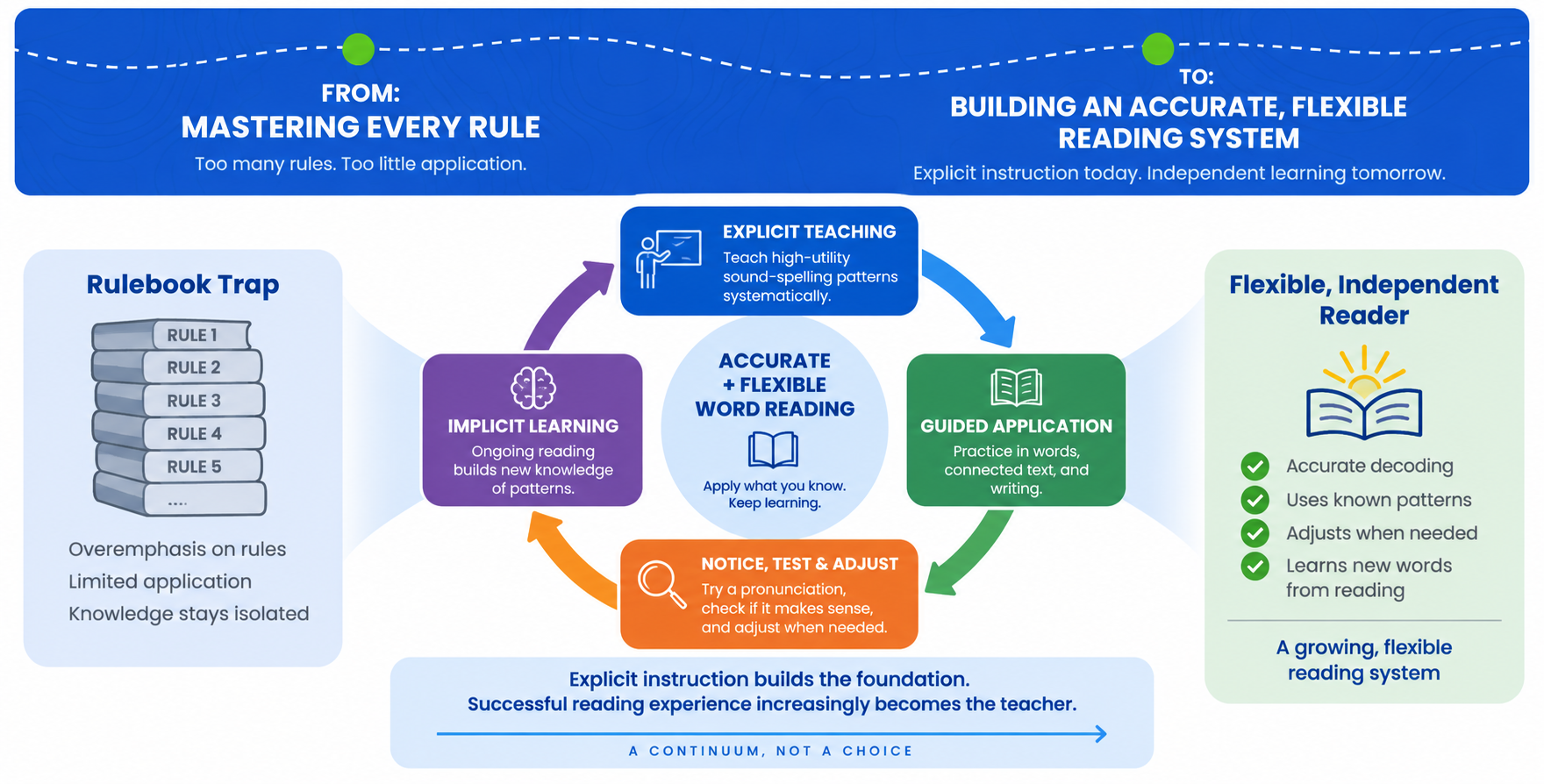
English has regularities, but it also has considerable variation. Students need explicit, systematic, and cumulative instruction in how sounds and spellings work. But the goal is not to memorize an ever-expanding inventory of rules before using those patterns in real reading and writing.
Instead, explicit instruction should give students a strong foundation in the most useful patterns of the English writing system—and repeated opportunities to apply that knowledge. As students read, they encounter new words and variations, test what they know, adjust when necessary, and gradually expand their knowledge of the system. Explicit teaching and implicit learning are not competing approaches; they work together. Explicit instruction builds the foundation, while successful reading experience increasingly allows students to extend that knowledge independently. The Shanker Institute describes explicit instruction as an important “onramp” toward the point at which students can acquire more of the system through implicit learning (Shanker Institute, 2026).
This requires flexibility. Effective instruction helps students recognize high-utility patterns, apply them repeatedly, and learn what to do when English does not behave exactly as expected. Rather than abandoning decoding, students can try a plausible pronunciation, check it against a word they know, and adjust when necessary (Shanahan, 2022).
Some students will need substantially more explicit instruction, repetition, cumulative review, and guided practice than others. Responsive instruction does not lower the expectation for accuracy or replace systematic instruction. It changes the amount and type of support students need while continuing to move them toward independence.
For multilingual learners, this flexibility deserves particular attention. A student whose first language has a more transparent orthography may expect sound-symbol relationships to be highly consistent. English requires a somewhat different understanding: patterns are powerful and worth learning, but they are not absolute. Students need both a strong foundation in the English code and opportunities to use that knowledge flexibly—applying known patterns, checking whether a pronunciation produces a known word, adjusting when necessary, and gradually learning more about English orthography through successful encounters with print.
The goal is not a student who has memorized every rule. It is a student who knows the system well enough to use it accurately, flexibly, and increasingly independently—and to keep learning from reading itself.
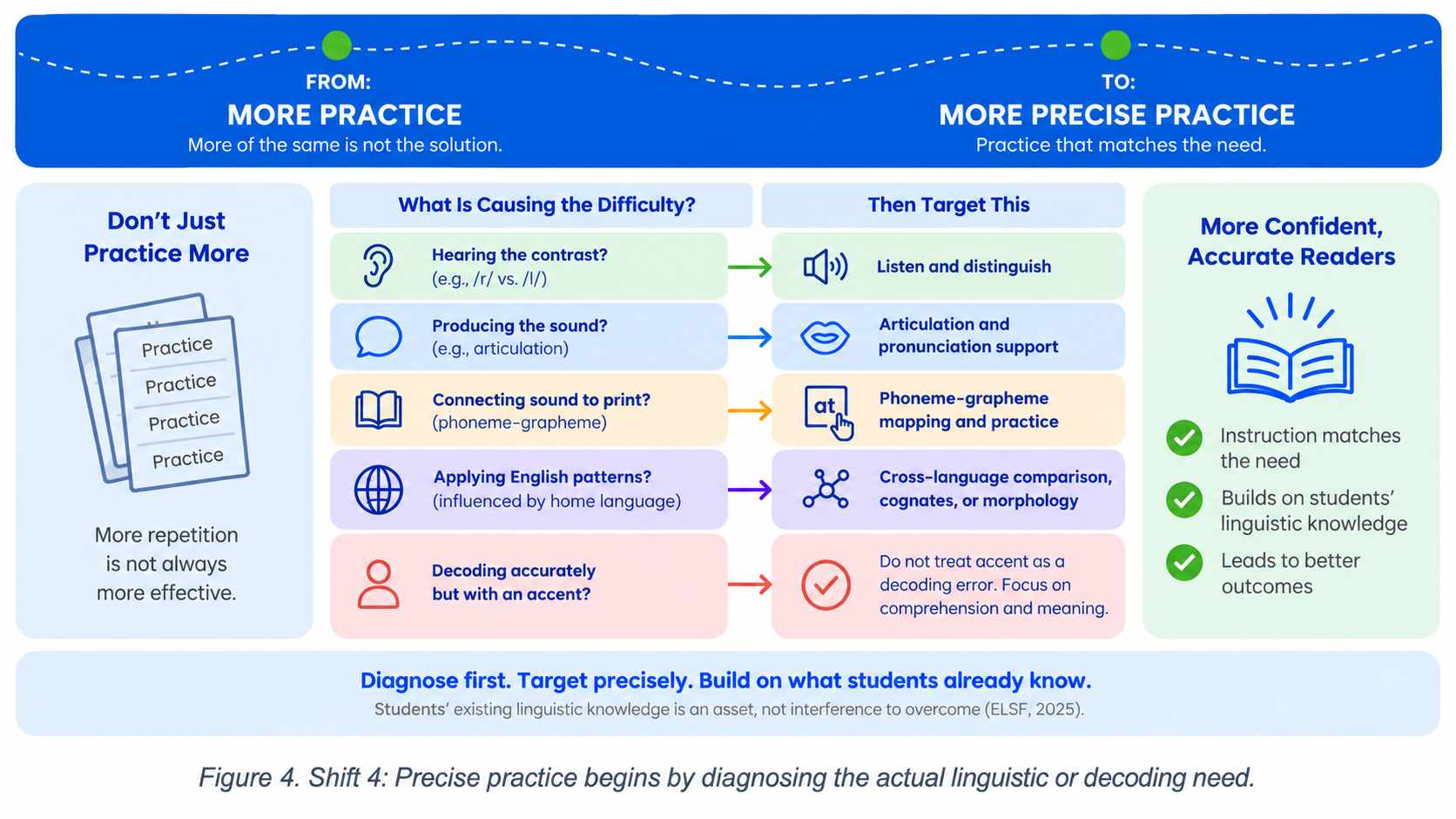
When a multilingual learner struggles with an English sound or spelling pattern, the answer is not automatically more repetition. First determine what is causing the difficulty.
Can the student hear the sound distinction? Produce the sound? Connect the phoneme to the grapheme? Does the sound exist in the student's home language, or is the student applying a familiar sound pattern from another language? Or is the student decoding the word accurately but pronouncing it with features of their accent?
These are different instructional needs—and they require different responses. Precise practice targets the source of difficulty rather than simply increasing the amount of practice.
Teachers can draw on students' existing linguistic knowledge through cross-language comparisons, cognates, morphology, and brief metalinguistic conversations that make similarities and differences visible. The home language becomes a resource for understanding how English works, not an interference to overcome (English Learners Success Forum [ELSF], 2025).
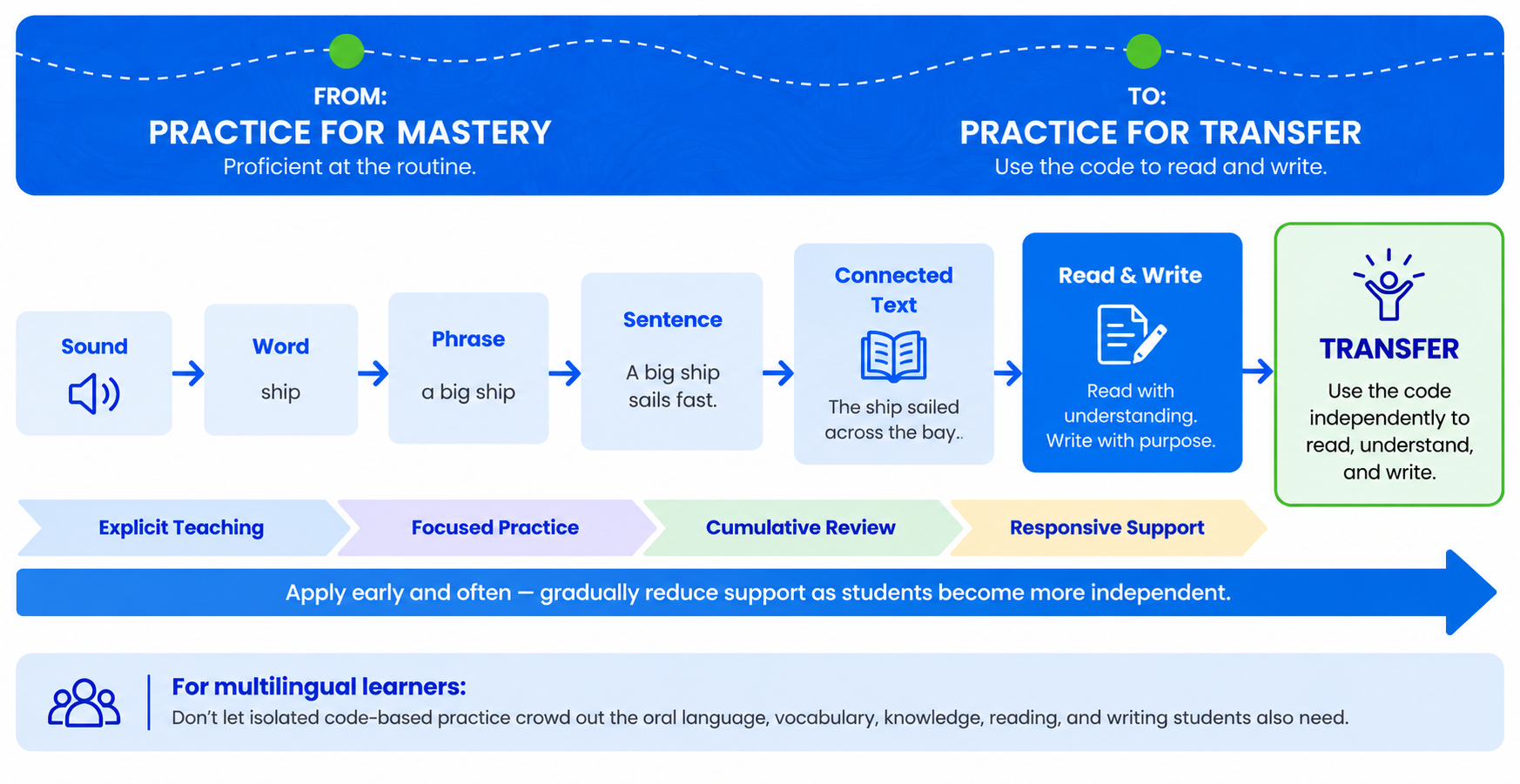
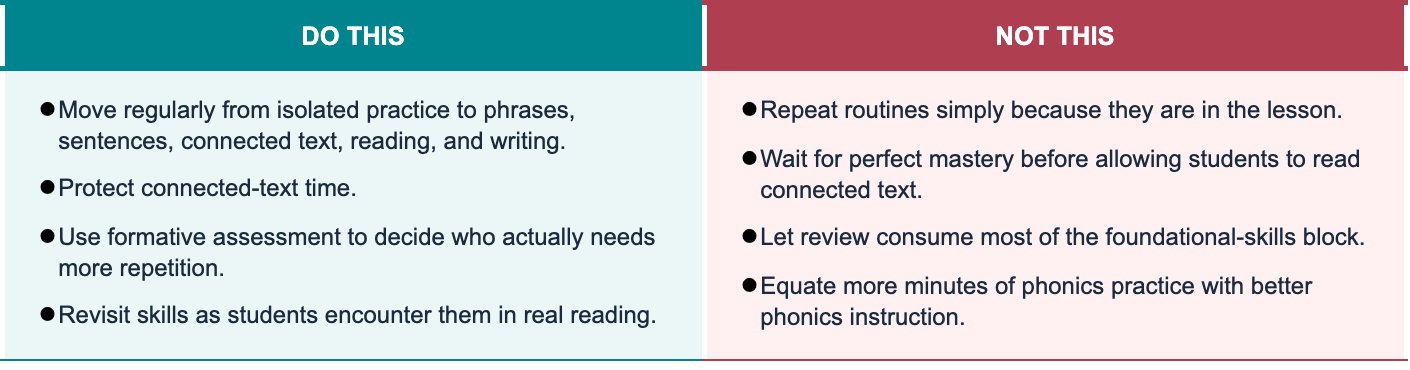
Move into meaningful reading and writing early and often. Adjust support—not the goal. Practice matters. Accuracy and automaticity matter. But the purpose of foundational-skills instruction is not to become proficient at a phonics routine. It is to use the code independently in reading and writing.
Students build proficiency through explicit instruction, interleaved, practice, cumulative review, and repeated application. These should not operate as separate stages in which students must first “master” a skill in isolation before using it. Practice and application work together.
Instruction should deliberately move students across increasingly meaningful contexts:
sound → word → phrase → sentence → connected text → authentic reading & writing
Students will move through this progression at different rates. Some need substantially more modeling, repetition, and cumulative review. Responsive instruction provides that additional support without unnecessarily postponing opportunities to read, write, build language, and make meaning.
This is especially important for multilingual learners. Time spent on isolated code-based practice has an opportunity cost when it displaces the oral language, vocabulary, knowledge building, reading, and writing students also need to become proficient readers of English.
The goal, then, is not simply more phonics or faster phonics. It is enough explicit instruction and practice to build accuracy and automaticity—and enough meaningful application for those skills to transfer. Current evidence does not establish one phonics approach as universally superior when instruction follows a clear scope and sequence and is explicit, systematic, and cumulative; students also vary in how much explicit instruction and practice they need (Schwartz, 2026a, 2026b).
Success is not mastery of the routine. Success is transfer: students independently using what they have learned to read, understand, and write.
These five shifts tell one increasingly sophisticated story: teach the code explicitly, connect it to language and meaning, use meaning appropriately, develop flexibility, diagnose rather than over-practice, and move relentlessly toward transfer—without allowing foundational skills to crowd out the rest of learning to read and reading to learn.
Foundational skills belong inside a comprehensive, knowledge-building approach to literacy. Phonemic awareness, phonics, decoding, spelling, and fluency are necessary—but they are not sufficient. Students also need language, vocabulary, knowledge, comprehension, discussion, reading, and writing, and these components develop together rather than waiting for one another to be “finished” (Scientific Advisory Committee, Knowledge Matters Campaign, 2023a).
For multilingual learners, that integration is especially consequential. They are developing the English code while also expanding oral language, vocabulary, academic language, background knowledge, and comprehension. Their home languages, experiences, and existing knowledge are resources for that learning—not obstacles to put aside while they learn phonics.
There is also an opportunity cost. When extended phonics review or isolated practice routinely displaces read-alouds, connected reading, writing, discussion, science, and social studies, students lose experiences that build the very language and knowledge they need for comprehension. More foundational-skills time is not automatically better foundational-skills instruction. The goal is more intentional use of instructional time.
Teach the code explicitly.
Build language intentionally.
Build knowledge systematically.
Move students into meaningful reading, writing, and discourse.
These are not competing priorities. They are how children become readers.
That does not mean less attention to foundational skills. It means more intentional use of instructional time.
The Knowledge Matters Scientific Advisory Committee specifically recommends safeguarding science and social studies, noting that even a content-rich ELA curriculum cannot substitute for strong instruction in those disciplines (Scientific Advisory Committee, Knowledge Matters Campaign, 2023d).
For multilingual learners, the opportunity cost is especially high. They are learning the English code while also expanding English vocabulary, oral language, academic language, background knowledge, and comprehension. We cannot accelerate one part of that development by starving the others.
The goal is coherence.
Teach the code explicitly. Build language intentionally. Build knowledge systematically. Protect time for meaningful reading, writing, speaking, listening, science, and social studies.
These are not competing priorities.
They are how children become readers.
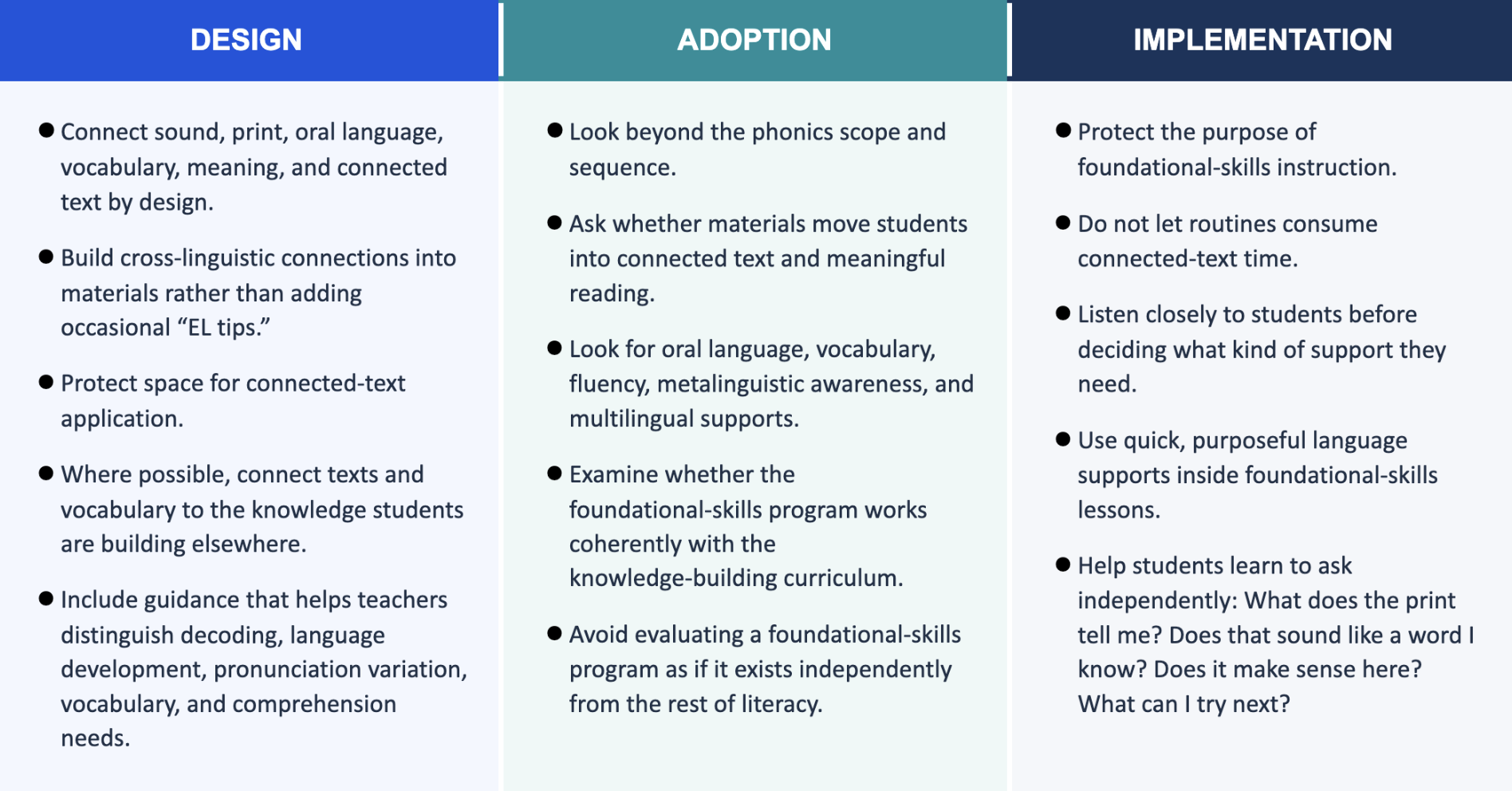
This companion gives teachers a quick way to decide what to do in the moment without losing sight of the larger literacy system. The recommendations synthesize the research and guidance cited throughout the brief. The seven implementation areas translate the article’s five-shift framework into practical classroom guidance.
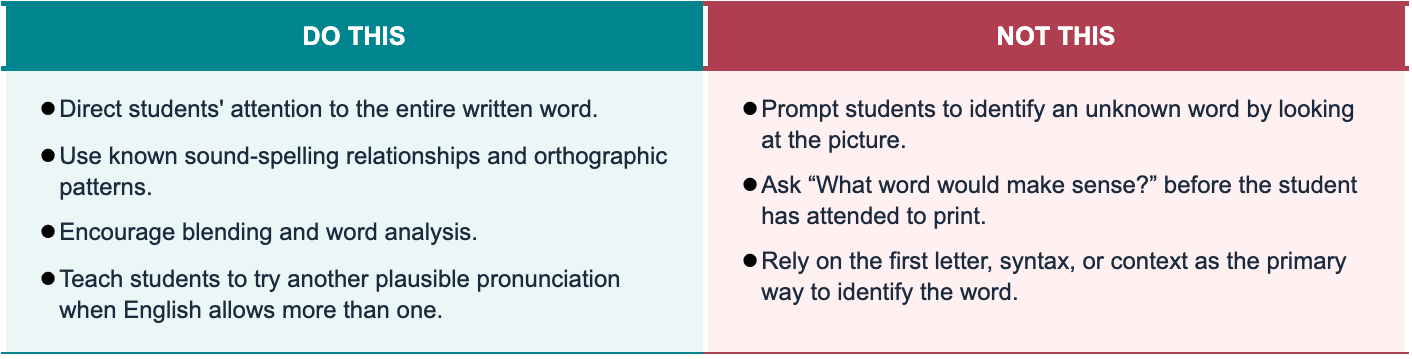
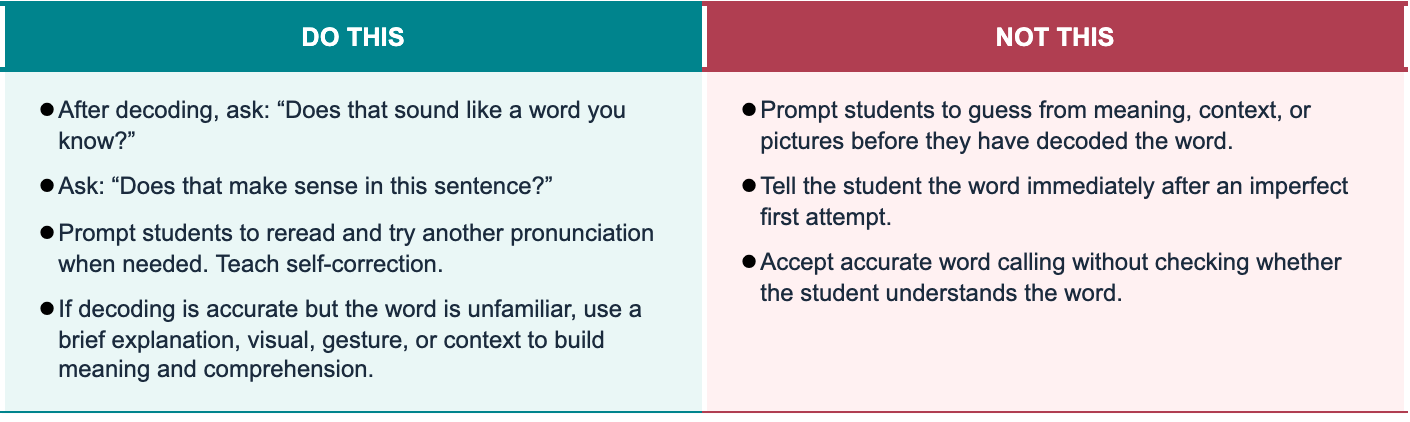
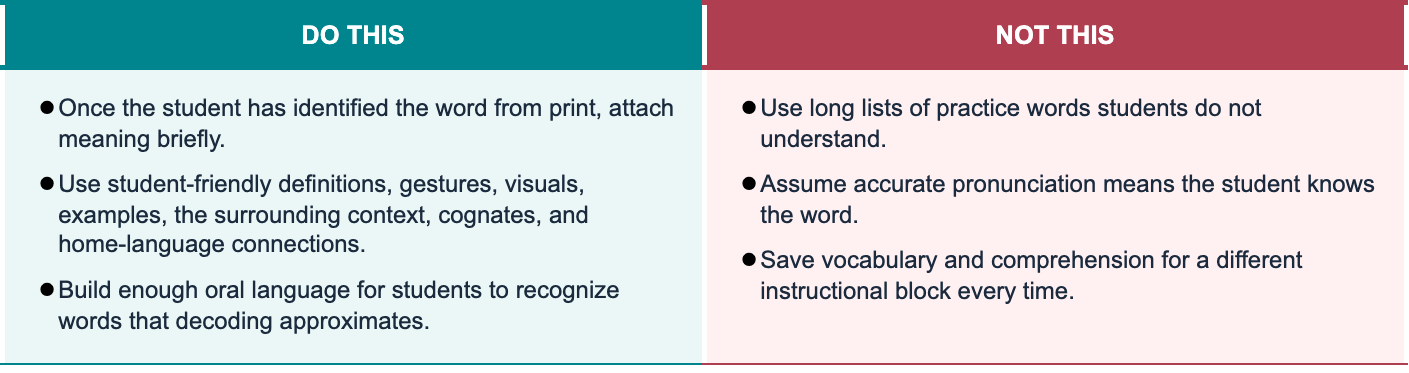
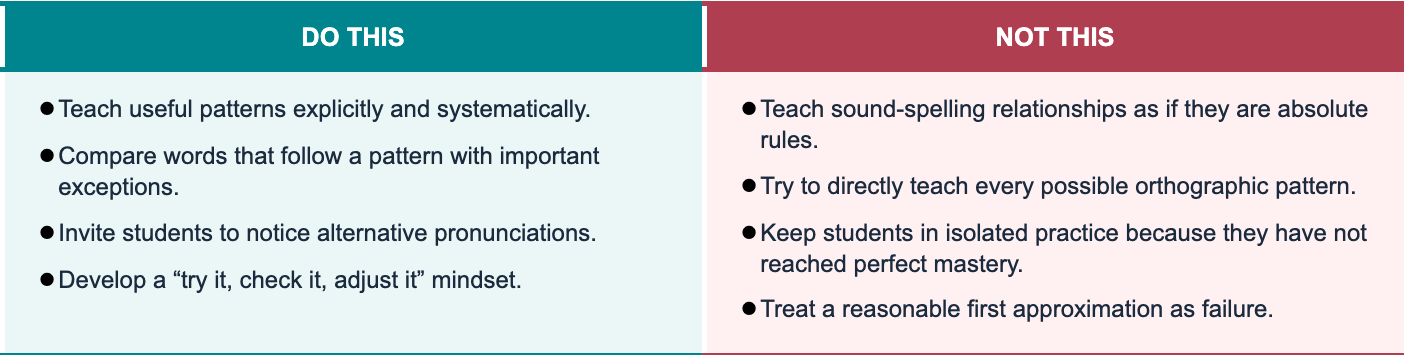
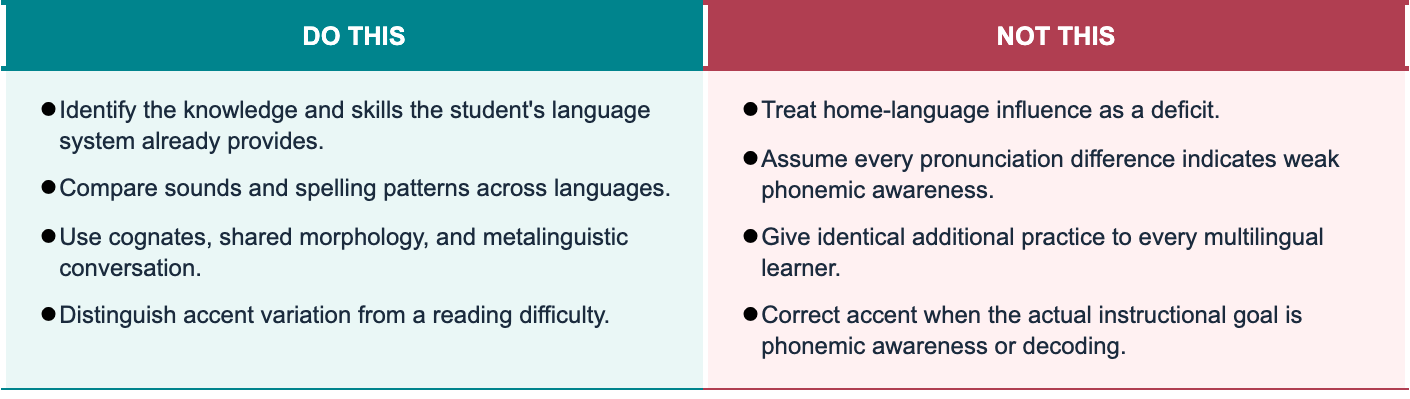
Adapted from Nell K. Duke’s “When Young Readers Get Stuck,” with additional considerations for multilingual learners.
When a reader gets stuck, first identify the problem the student is trying to solve. The prompt should match the need. Duke’s framework distinguishes word identification from comprehension monitoring, vocabulary, and comprehension—an especially important distinction for multilingual learners (Duke, 2020).
If the difficulty centers on a sound, determine whether the English phoneme is present, absent, or approximated in the student’s home language. Provide targeted listening or articulation support when needed; do not automatically assign more phonics practice.
Use meaning only after a decoding attempt. If the student decodes accurately but does not know the word in spoken English, use a brief explanation, visual, gesture, or the surrounding context to establish meaning and support comprehension. These supports build meaning; they do not replace attention to print.
Distinguish decoding from pronunciation and accent variation. If the student decoded the spelling accurately and meaning is intact, do not treat accent variation as a decoding error. If the word is not yet part of the student's oral English vocabulary, say it, establish meaning briefly, and have the student reread it.
Decoding a word and knowing it in English are not the same thing. When decoding is accurate but the word is unfamiliar, visuals and context can build meaning and support comprehension. Connect the printed form to meaning without turning the phonics lesson into an extended vocabulary lesson.
Consider whether the difficulty reflects decoding, language comprehension, unfamiliar vocabulary, syntax, text structure, or needed background knowledge. Provide the language or knowledge support the student needs to keep making meaning.
Duke, N. K. (2020, November 1). When young readers get stuck. Educational Leadership, 78(3). ASCD. https://www.ascd.org/el/articles/when-young-readers-get-stuck
English Learners Success Forum. (n.d.). Instructional materials for code-based reading skills: Design challenges and opportunities for multilingual learners.
English Learners Success Forum. (2025, February 24). 4 critical shifts needed in English language development materials to meet the needs of multilingual learners. https://www.elsuccessforum.org/blog/4-critical-shifts-needed-in-english-language-development-materials-to-meet-the-needs-of-multilingual-learners
Foorman, B. R., Beyler, N., Borradaile, K., Coyne, M., Denton, C. A., Dimino, J., Furgeson, J., Hayes, L., Henke, J., Justice, L., Keating, B., Lewis, W., Sattar, S., Streke, A., Wagner, R., & Wissel, S. (2016). Foundational skills to support reading for understanding in kindergarten through 3rd grade (NCEE 2016-4008). National Center for Education Evaluation and Regional Assistance, Institute of Education Sciences, U.S. Department of Education. (Revised 2019). https://ies.ed.gov/ncee/WWC/Docs/PracticeGuide/wwc_foundationalreading_040717.pdf
Jennerjohn, A., Rutherford-Quach, S., Cassidy, L., Woodworth, K., Dec, S., & Reynolds, D. (2026). Bridging the divide: Connecting word recognition and language comprehension in early literacy [Learning brief]. SRI. https://www.sri.com/publication/education-learning-pubs/bridging-the-divide-connecting-word-recognition-and-language-comprehension-in-early-literacy/
Quintero, E. (2025, September 5). The mindsets we bring to understanding reading laws. Albert Shanker Institute.https://www.shankerinstitute.org/blog/mindsets-we-bring-understanding-reading-laws?
Scientific Advisory Committee, Knowledge Matters Campaign. (2023a, February 28). Looking to research for literacy success. ASCD. https://www.ascd.org/blogs/looking-to-research-for-literacy-success
Scientific Advisory Committee, Knowledge Matters Campaign. (2023b, March 7). The language basis of knowledge. ASCD.
Scientific Advisory Committee, Knowledge Matters Campaign. (2023c, March 14). Helping students access complex, knowledge-rich texts. ASCD.
Scientific Advisory Committee, Knowledge Matters Campaign. (2023d, March 21). Setting the conditions for building knowledge. ASCD. https://ascd.org/blogs/setting-the-conditions-for-building-knowledge
Shanahan, T. (2022, September 26). Phonics and flexibility—Can they really go together? Reading Rockets. https://www.readingrockets.org/blogs/shanahan-on-literacy/phonics-and-flexibility-can-they-really-go-together
Schwartz, S. (2026a, March 11). Phonics is crucial. But how much is too much? Education Week. https://www.edweek.org/teaching-learning/phonics-is-crucial-but-how-much-is-too-much/2026/03
Schwartz, S. (2026b, August 7). What is ‘linguistic’ phonics and why are some schools adopting it? Education Week. https://www.edweek.org/teaching-learning/what-is-linguistic-phonics-and-why-are-some-schools-adopting-it/2026/08